
The Physical Truth Layer
Beyond Monitoring — Deterministic Verification for High-Density Compute
Beyond Monitoring
In the era of 1,000W+ high-density compute architectures, infrastructure risk is no longer defined by capacity limits—it is defined by stability limits.
Standard monitoring systems rely on software-layer dashboards, time-averaged metrics, and reactive threshold alerts. Yet, at the 2nm silicon scale, performance degradation and catastrophic failures rarely originate from averages. They emerge from the invisible: sub-millisecond transients, non-linear resonance, localized thermal snapping, and power-delivery variability ($dP/dt$).
QH8 Systems closes this structural blind spot. We move infrastructure from reactive assumptions and faith-based telemetry to Deterministic Physical Verification.
The QH8 Governance Stack
Our architecture establishes a three-tier physical governance layer that secures the entire hardware lifecycle—from real-time operation to long-term asset valuation.
1. Operational Governance — v012 Obsidian
The Problem: Software logs can be wiped, spoofed, delayed, or corrupted, leaving no verifiable evidence of physical stress or envelope violation.
The Solution: High-resolution, hardware-rooted telemetry that establishes deterministic baselines of power, thermal, and behavioral state.
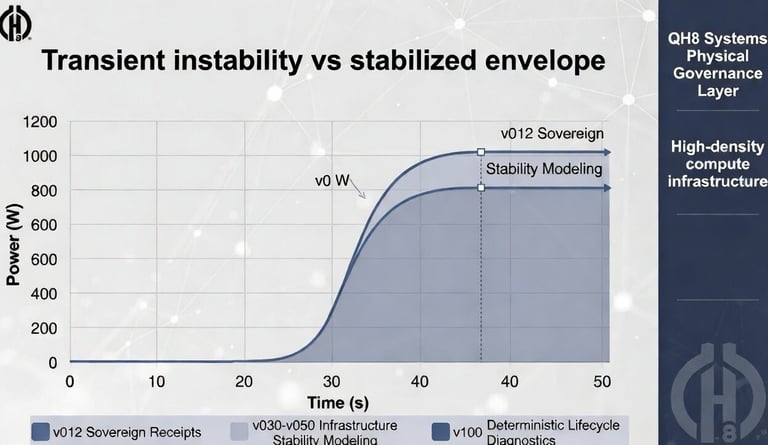
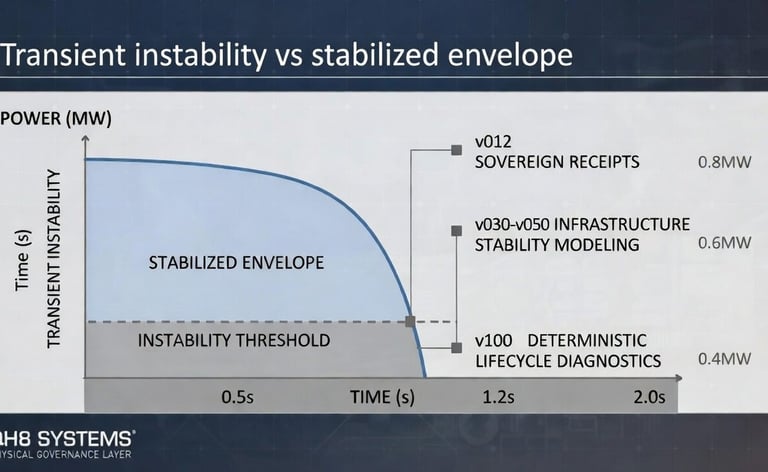
The Deliverable: Sovereign Receipts. Every micro-transient violation is captured at 15–20ms granularity and cryptographically sealed (SHA-256 chained). These receipts provide forensic-grade proof of integrity, compliance, and operational envelope adherence.
2. Stability Modeling — v030–v050 Equilibrium
The Problem: Rapid power ramps and variability in delivery cause "silent fatigue," cooling inefficiency, and unpredictable thermal transients that erode hashrate and lifespan.
The Solution: Continuous mapping of instability patterns, transient stress, and load-interaction dynamics to enable active stabilization and control tuning.
The Deliverable: A Stabilized Operational Envelope. By minimizing variability-driven inefficiency and preventing thermal snaps, we enable deterministic behavior under extreme density.
3. Lifecycle Diagnostics — v100 Sovereign
The Problem: Assessing the true health, degradation trajectory, and Remaining Useful Life (RUL) of high-utilization hardware remains opaque and subjective.
The Solution: Non-destructive condition assessment using Bayesian Power Signature Analysis and multi-domain correlation.
The Deliverable: Quantitative Asset Transparency. We provide insight into degradation drivers and remaining lifespan—enabling accurate valuation, warranty adjudication, and capital-market transparency for compute fleets.
The Objective: Deterministic Resilience
As compute fleets grow more capital-intensive and failure costs become nonlinear, resilience depends not on utilization alone, but on a verifiable understanding of the silicon’s physical state behavior.
QH8 Systems transforms the "physical blind spot" into a transparent, auditable truth layer—moving the industry from reactive monitoring to Sovereign Governance.
Ready to Close the Trust Gap?
We are accepting a limited number of pilot engagements for infrastructure operators, AI providers, and institutional asset managers who require forensic certainty at the physical layer.
Technical & Legal Disclaimer
Detection of instability patterns (v012) and stabilization modeling (v030–v050) are designed to mitigate degradation and prevent non-linear failure events. However, QH8 Systems does not guarantee the prevention of all hardware failures, as silicon degradation is subject to numerous environmental and manufacturing variables beyond the scope of external telemetry.