Deep Insight into Silicon Failure Mechanisms

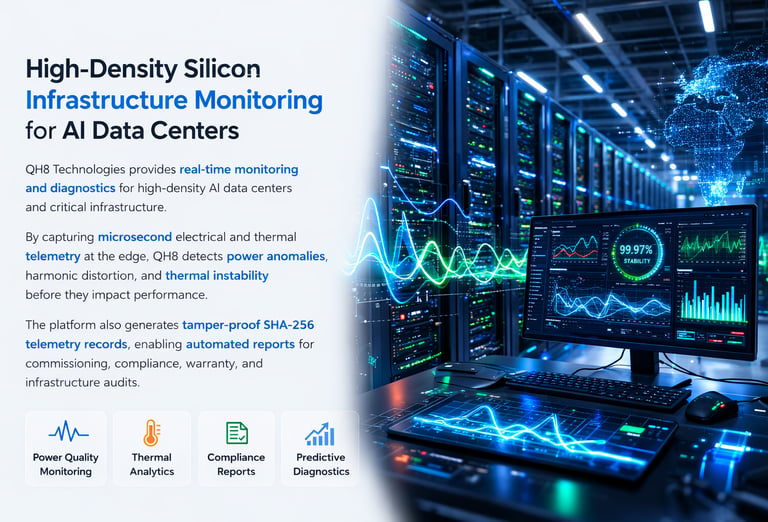
QH8 Technologies conducts independent, offline audits of advanced silicon systems operating under real-world electrical, thermal, and mechanical stress.

Our approach identifies cross-domain failure modes and long-term reliability risks that are not visible through traditional simulation, monitoring, or point-tool analysis.

Close-up of a high-power AI accelerator chip with visible intricate circuitry.

Our Approach

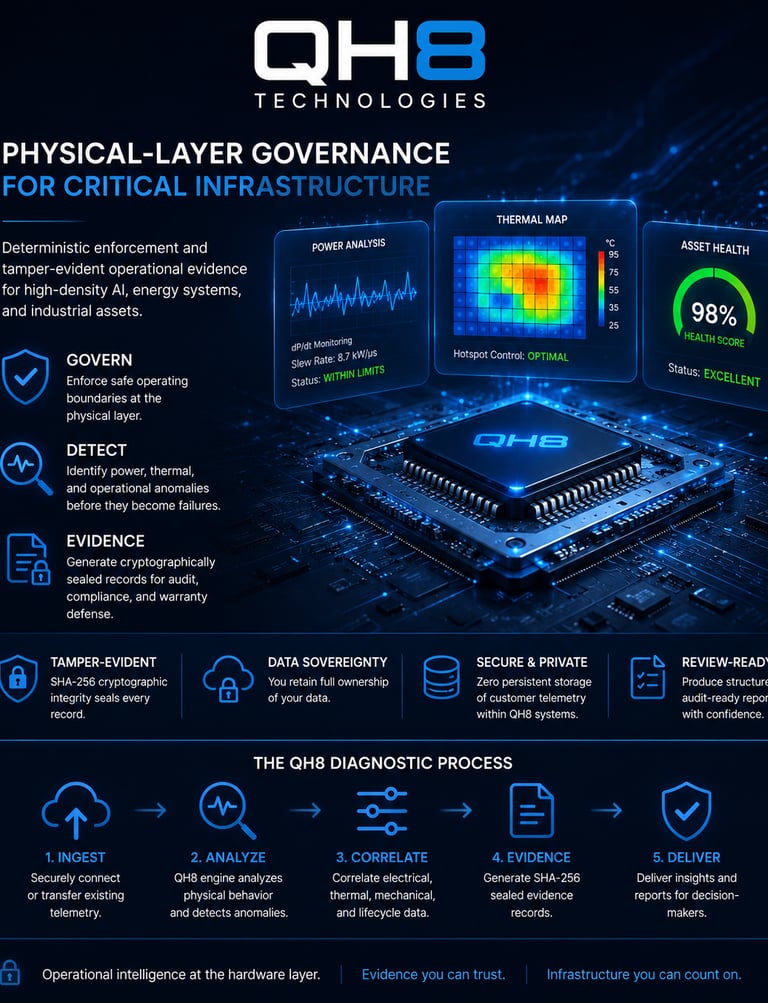
QH8 performs system-level silicon reliability audits that operate beyond traditional point tools and telemetry dashboards.

We analyze how thermal, electrical, mechanical, and lifecycle stresses interact across the full operating envelope of advanced silicon, including high-power AI and data-center workloads.

Rather than monitoring isolated metrics, QH8 applies a multi-domain governance model to identify hidden failure modes, cumulative damage mechanisms, and long-term reliability risks before they manifest in the field.

All audits are conducted offline, securely, and non-invasively, producing decision-grade reports for engineering and executive teams.

Our Services

Independent, offline audits of advanced silicon systems operating at physical limits.
Silicon Reliability Audit

Close-up of a high-tech silicon chip under thermal imaging highlighting stress points.

Black-box assessment of advanced silicon under real electrical, thermal, and mechanical stress to identify latent failure modes and lifetime risks.

Visualization of power integrity dynamics within a complex AI accelerator.
3D-IC architecture model showing layered silicon components and thermal hotspots.
System-Level Risk Analysis

Cross-domain analysis exposing interactions between power delivery, thermal behavior, and device aging that are not visible in isolated design tools.

Actionable findings that support architecture, validation, and deployment decisions without exposing proprietary designs or requiring toolchain integration.

Engineering Decision Support