Audit & Evidence
Tamper-evident records of
physical infrastructure behavior.
Modern critical infrastructure operates under electrical, thermal, mechanical, and operational stress.
Software logs, OEM dashboards, BMS records, and facility reports are useful, but they do not always prove how physical infrastructure behaved under real operating conditions.
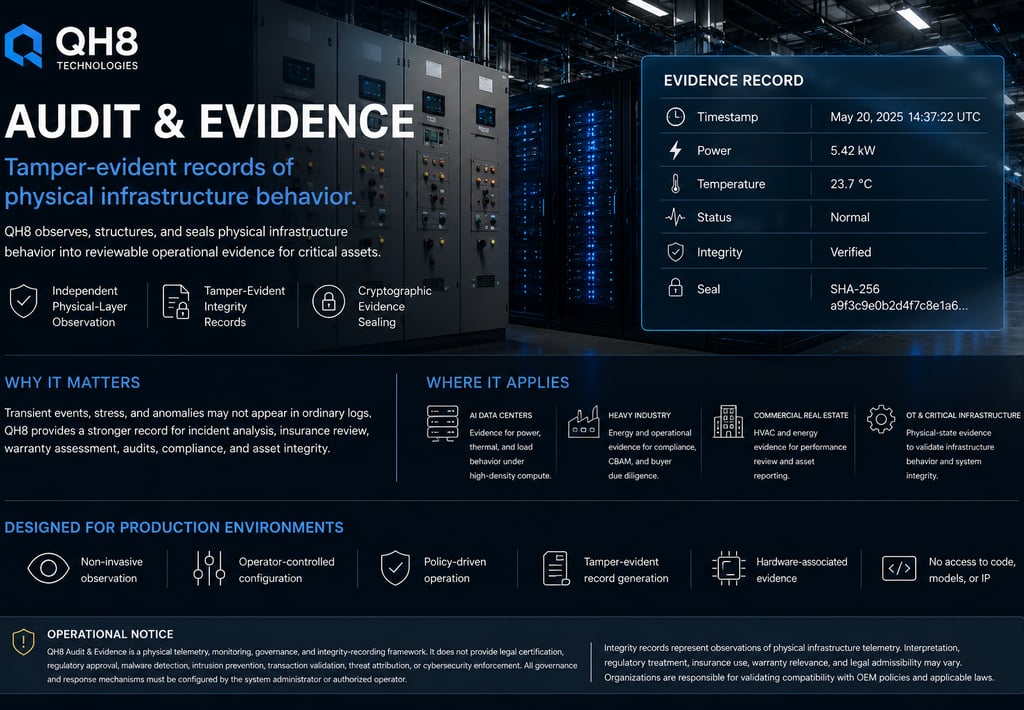
QH8 Audit & Evidence adds a physical-layer evidence system that observes, structures, and seals infrastructure behavior into tamper-evident operational records.
The purpose is simple:
Turn physical infrastructure behavior into reviewable evidence.
Why It Matters
Infrastructure events often leave incomplete evidence.
Transient power events, thermal drift, unstable load behavior, equipment stress, and physical-state anomalies may not appear clearly in ordinary logs or editable reports.
These gaps matter during:
Incident analysis
Insurance review
Warranty assessment
Investor due diligence
Infrastructure audit preparation
SLA investigations
EU-facing compliance documentation
Lifecycle asset integrity review
QH8 gives operators and stakeholders a stronger record of what happened before, during, and after relevant events.
Core Capabilities
Physical-Layer Observation
QH8 observes operating behavior such as power dynamics, thermal behavior, load instability, rate-of-change signals, boundary deviations, equipment stress, and physical-state anomalies.
Tamper-Evident Records
Observed behavior can be structured into timestamped integrity records with event chronology, telemetry context, policy status, and SHA-256 sealing where applicable.
Evidence Continuity
QH8 helps preserve the chain from physical behavior to sealed record to final report.
Policy-Controlled Governance
QH8 can support operator-defined policies such as detection, alerting, boundary review, soft governance signals, evidence receipts, and approved response logic.
QH8 does not require autonomous shutdown behavior.
Where It Applies
AI Data Centers
Supports review of power behavior, thermal stress, transient events, load instability, SLA investigations, warranty discussions, and lifecycle asset integrity.
Heavy Industry & Export Operations
Supports energy-use documentation, production-linked evidence, CBAM preparation, buyer review, investor due diligence, and technical audit preparation.Commercial Real Estate & HVAC
Supports HVAC operating review, energy-waste identification, mechanical stress indicators, contractor oversight, asset-performance review, and lender reporting.
OT & Critical Infrastructure
Adds physical-state evidence to help technical teams compare reported digital states against observed infrastructure behavior.
QH8 does not perform malware detection, intrusion prevention, threat attribution, or cybersecurity enforcement.Designed for Production Environments
QH8 is designed to supplement existing infrastructure systems without disrupting core operations.
Deployment may include:
Non-invasive observation
Operator-controlled configuration
Policy-driven operation
Tamper-evident record generation
Hardware-associated evidence where available
No required access to source code, AI models, or proprietary software logic
QH8 complements OEM systems, BMS platforms, SCADA environments, OT-security tools, and compliance workflows.
It does not replace them.
Operational Notice
QH8 Audit & Evidence is a physical telemetry, monitoring, governance, and integrity-recording framework.
QH8 does not provide legal certification, regulatory approval, malware detection, intrusion prevention, transaction validation, threat attribution, or cybersecurity enforcement.
Integrity records generated by QH8 represent observations of physical infrastructure telemetry and related operational context.
Interpretation, regulatory treatment, insurance use, warranty relevance, and legal admissibility may vary by jurisdiction, contract, organizational policy, and industry requirements.
All governance and response mechanisms must be configured by the system administrator or authorized operator.
Organizations remain responsible for validating compatibility with OEM warranty terms, vendor policies, safety procedures, operational requirements, and applicable laws.
Disclaimers & Operational Notice
QH8 Audit & Evidence is a physical telemetry and integrity-recording framework designed to supplement existing infrastructure, security, and compliance systems.
QH8 does not perform malware detection, intrusion prevention, cybersecurity enforcement, transaction validation, threat attribution, legal certification, or regulatory approval.
QH8 integrity records represent observations of physical infrastructure telemetry. Their interpretation, regulatory treatment, insurance use, warranty relevance, and legal admissibility may vary by jurisdiction, contract, policy, and industry requirements.
All governance and response settings must be configured and approved by the authorized operator.
Organizations remain responsible for validating compatibility with OEM warranty terms, vendor policies, safety procedures, operational requirements, and applicable laws.