Our Technology
Independent Physical-Layer
Governance for Critical Infrastructure
QH8 Technologies builds diagnostic and governance architecture for infrastructure where power behavior, thermal stress, equipment state, and operational evidence affect business risk.
Modern infrastructure cannot be managed by dashboards alone.
QH8 maps, validates, and seals physical behavior so operators can understand how assets performed, prove what happened, and decide what to fix first.
The Problem: Attribution, Not More Dashboards
Infrastructure systems already produce logs, alarms, dashboards, and reports.
The harder question is whether the operator can prove why a failure, inefficiency, compliance gap, or equipment dispute occurred.
Was it unstable power behavior?
Was it thermal stress?
Was it equipment degradation?
Was it BMS or control-logic drift?
Was there a mismatch between digital reporting and physical behavior?
QH8 strengthens the evidence layer beneath existing systems by connecting observed physical behavior to technical, financial, compliance, insurance, warranty, and operational decisions.
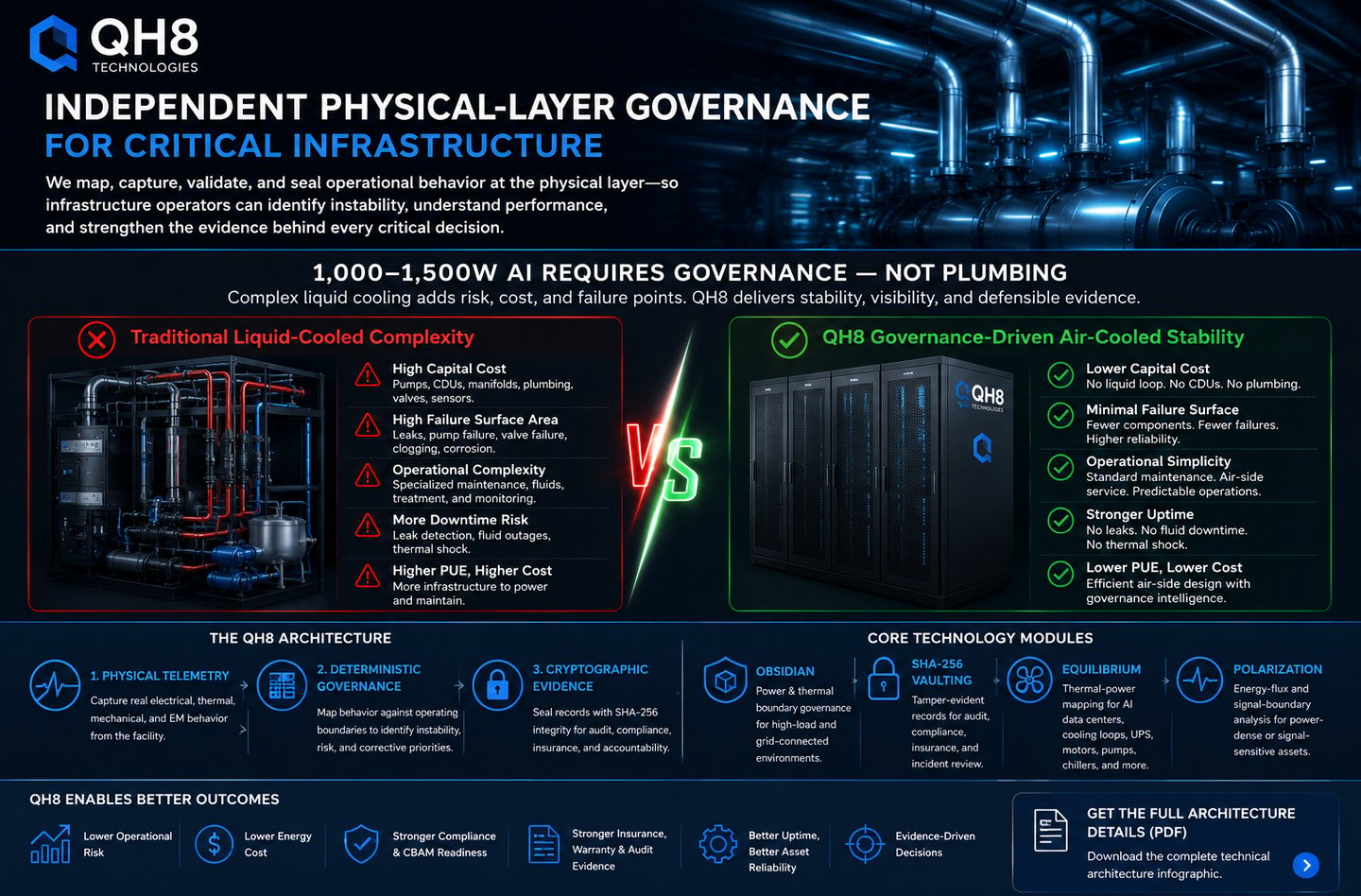
The QH8 Architecture
QH8 does not replace OEM equipment, BMS platforms, SCADA environments, OT-security tools, or compliance workflows.
It strengthens them with three layers.
1. Physical Telemetry
Captures real electrical, thermal, mechanical, electromagnetic, and operating-state behavior from the facility.
2. Deterministic Governance
Maps physical behavior against defined operating boundaries to identify instability, evidence gaps, and corrective priorities.
3. Cryptographic Evidence
Seals operational records into tamper-evident evidence packages for review, reporting, and accountability.
Core Technology Modules
OBSIDIAN
Power and thermal boundary governance for high-load, unstable, or grid-connected environments.
SHA-256 Vaulting
Tamper-evident timestamped records for audit, compliance, insurance, warranty, and incident review.
EQUILIBRIUM
Thermal-power mapping for AI data centers, cooling loops, UPS assets, motors, pumps, chillers, and compressors.
POLARIZATION
Energy-flux and signal-boundary analysis for power-dense or signal-sensitive infrastructure without interfering with protected system logic.
What QH8 Enables
AI / Data Centers
Thermal-power mapping, load volatility review, cooling-loop instability detection, and evidence for uptime and equipment reliability.
Industrial Exporters
Stronger energy and carbon-data evidence for CBAM preparation, buyer review, and compliance documentation.
Commercial Buildings
HVAC/BMS logic-drift detection, cooling inefficiency analysis, demand-spike review, and contractor-performance visibility.
OT Environments
Physical-layer validation that helps compare reported digital states against actual machine behavior.
Insurance / Warranty
A stronger operational evidence record for claims preparation, vendor discussions, attribution, and technical review.
What QH8 Does Not Do
QH8 is not a conventional dashboard.
QH8 is not a replacement for OEM equipment.
QH8 is not a substitute for certified engineering, legal, insurance, customs, or regulatory judgment.
QH8 is not an OT-security platform replacement.
QH8 strengthens the systems operators already use.
Know how the asset behaved.
Prove what happened.
Act before instability becomes loss.
Disclaimer
QH8 Technologies provides infrastructure diagnostics, telemetry analysis, evidence structuring, and risk-intelligence support. Outputs are informational and not guarantees of savings, compliance approval, insurance outcomes, audit acceptance, or regulatory determinations. Final decisions remain with the client and its authorized advisors. Binding commitments exist only within executed written agreements.
Evidence Verification
Verify the record before relying on the report.
QH8 evidence records are designed to be checked, not simply trusted.
A QH8-sealed evidence package may include a unique SHA-256 integrity record connected to facility telemetry, infrastructure documentation, asset-passport data, audit evidence, CBAM-supporting records, or other operational evidence files.
Authorized reviewers can use this record to confirm whether a submitted file matches the original sealed evidence package.
How It Works
A QH8-sealed report, evidence file, asset passport, or technical record is generated.
The document includes a SHA-256 integrity reference.
The reviewer opens the QH8 verification registry or approved verification link.
The submitted file is checked against the registered integrity record.
If the file was changed after sealing, the verification result will not match.
What the Hash Proves
The SHA-256 record helps confirm that the submitted file matches the sealed evidence record.
It supports:
Document integrity
Tamper-evident review
Evidence traceability
Audit preparation
Asset-passport verification
Reviewer confidence
The hash verifies file integrity.
It does not replace auditors, regulators, certification bodies, insurers, banks, legal counsel, or statutory authorities.