v010-DENSITY
Vertical Thermal Governance — The Architectural Standard for 3D-IC & HBM4
1. The Vertical Bottleneck
As compute infrastructure transitions to 3D-stacked silicon (12-layer HBM4, CoWoS, and advanced 3D-ICs), the industry has reached the Lateral Thermal Wall.
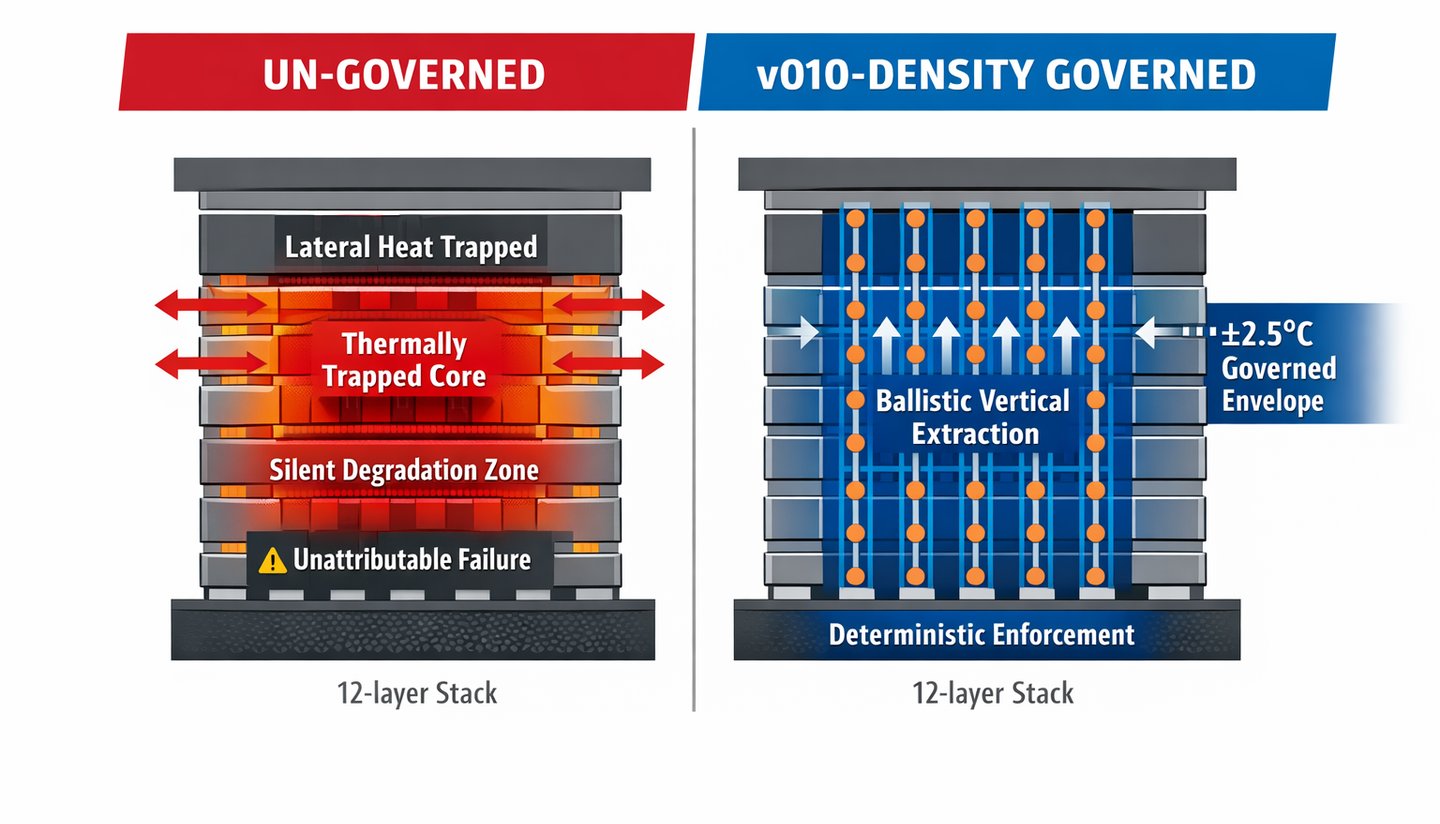
Conventional cooling methods — air or liquid — cannot penetrate or resolve heat accumulation inside the vertical core of stacked silicon. Heat becomes trapped between internal layers, beyond the reach of surface-based mitigation.
v010-DENSITY is the mandatory architectural pre-condition for governing vertical thermal gradients.
It converts uninsurable thermal black boxes into governable, high-density infrastructure assets.
2. The Failure Mode: Vertical Gradient Collapse
In 8–12 layer HBM stacks, the central layers (typically Layers 4–8) become thermally isolated.
At sustained loads exceeding ~1,000W per stack, lateral diffusion is physically insufficient, leading to:
Silent Data Corruption
Inter-layer bit errors caused by localized thermal runaway.Structural Fatigue
Non-linear thermal expansion resulting in TSV shear and microfractures.Uninsurability
Absence of deterministic loss attribution during catastrophic failure events.
Without vertical governance, these systems fail stochastically, not predictably.
3. v010-DENSITY Architecture (A → Z)
v010 is not a single component. It is a three-stage architectural integration.
A. Physical Layer (GDSII): Ballistic Phonon Steering
QH8 provides GDSII-level specifications for aligned TSV chains and fractal thermal structures.
These form deterministic vertical heat pathways (“ballistic phonon highways”) that enable controlled thermal extraction through the silicon lattice, rather than lateral diffusion.
B. Logic Layer (v008 Master Vault)
Vertical gradient telemetry is governed by Delta-Equilibrium Logic executed inside the v008 Master Vault — a hardware-secured, OS-independent enclave.
Monitoring and enforcement operate on sub-20ms time constants, independent of firmware, drivers, or vendor telemetry.
C. Deterministic Enforcement
If a vertical gradient exceeds the Sovereign Safety Envelope (±2.5 °C), the v010 kernel intercepts power requests at the PMIC level — before material failure physics can engage.
This is pre-failure governance, not reactive throttling.
4. Performance Envelope: The 2.5× Density Multiplier
Metric Ungoverned Infrastructure v010- DENSITY Governed Maximum Rack Density~120 kW (Air-cooled limit) 300 kW (Air-cooled) Vertical Thermal Gradient ±15 °C (Unstable) ±2.5 °C (Governed) Hardware Life Cycle Probabilistic Deterministic (Miner’s Rule) Insurability Status Excluded / High-RiskCertified / Governable
v010 does not “cool harder.”
It makes density governable.
5. Forensic Attribution (SHA-256 Receipts)
Every governed cycle produces a cryptographically sealed forensic receipt (SHA-256).
This provides post-incident “black box” evidence for:
Liability Isolation
Distinguishing manufacturing defects from operational excursions.Actuarial Ground Truth
Verifiable proof that infrastructure remained within certified envelopes.
Without this evidence, high-density 3D-IC failures are unattributable and uninsurable.
6. IP Integrity: The Sovereign Stack
All v010 logic and delta-equilibrium calculations execute inside the v008 Master Vault.
Proprietary thermal algorithms remain opaque and non-extractable
Outcomes are transparent, verifiable, and cryptographically sealed
No reverse-engineering exposure, no vendor lock-in risk
The result is provable governance without disclosure of methods.
Technical Audit & Insurability Certification
Before deploying infrastructure beyond 200–300 kW per rack, deterministic vertical governance is no longer optional.
QH8 provides:
GDSII-level simulation and review
Vertical gradient certification
Insurability readiness assessment for 3D-IC clusters
Verify your path to density before you build it.
Request Technical Audit contact@qh8technologies.com
Final Position
Infrastructure does not fail because it runs hot.
It fails because it runs ungoverned in the vertical dimension.
v010-DENSITY is the architectural standard that makes 300 kW air-cooled infrastructure governable, attributable, and insurable.