QH8 Technologies — The Deterministic Governance Standard
Deterministic Thermal-Power Governance for the 2nm Era
Modern infrastructure no longer fails because of software bugs or cyberattacks.
It fails because physics intervenes faster than legacy systems can respond.
At 1,000–2,000W per device, damage occurs in microsecond-to-millisecond transients—long before traditional cooling, monitoring, or human intervention can react.
QH8 Technologies exists to govern that moment.
The Problem: Reactive Systems in a Deterministic World
Legacy thermal management is observational:
Temperatures are measured after heat accumulates
Cooling responds with mechanical inertia (seconds, not milliseconds)
Liability is debated after damage occurs
This model worked at 500W.
It fails catastrophically at 2nm scale.
The QH8 Standard
QH8 introduces deterministic thermal-power governance:
Power is governed before the lattice enters a failure regime
Enforcement occurs in sub-20ms
Every operating cycle generates a cryptographically sealed forensic receipt (SHA-256)
This is not cooling.
This is risk elimination by design.
Why QH8 Is a Standard, Not a Product
Cooling systems manage heat
Monitoring systems report damage
QH8 governs eligibility to generate heat
In regulated infrastructure, that distinction defines insurability.
If it cannot be proven, it cannot be insured.
QH8 makes proof native.
— TECHNOLOGY ROADMAP
The QH8 Governance Roadmap (v008 → v012)
QH8 is architected as a progressive replacement of legacy thermal infrastructure, not an add-on.
Each version increases sovereignty while reducing mechanical dependency.
Phase I — v008-OBSIDIAN (Current Standard)
Deterministic Enforcement
Phase III — v010-DENSITY and Beyond
Zero-Pipe Architecture
Primary Vector
Ballistic phonon geometry & vertical heat transport
Scope
3D-IC, HBM, stacked architectures
Outcome
Mechanical cooling infrastructure becomes optional
Water systems become economically unjustifiable
This is the end of plumbing-first data centers.
— MATERIAL-AGNOSTIC GOVERNANCE
QH8 Is Not a Chip Technology
QH8 is a material-agnostic thermal-power governance framework.
Silicon is merely the first domain where failure became unavoidable.
The Governing Principle
If a system:
Generates concentrated energy
Suffers irreversible damage from heat or transients
Fails faster than mechanical systems can react
Then it can be governed by QH8.
Strategic Licensing Domains (Non-Exhaustive)
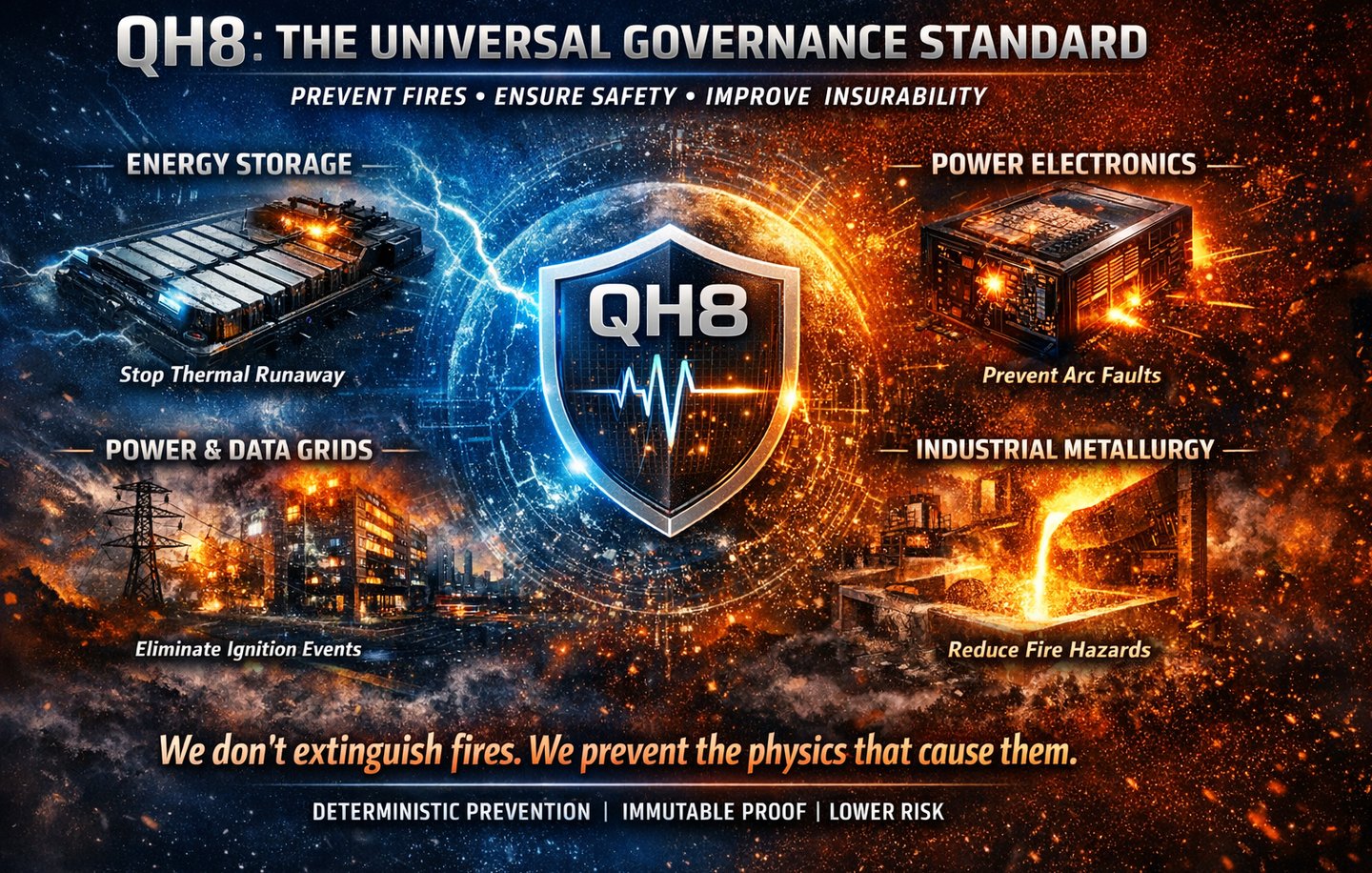
SectorFailure ModeQH8 Governance VectorEnergy StorageHotspots, chemical agingThermal-velocity synchronizationPower GridsTransmission heat lossAnti-resonance field governanceMetallurgyThermal gradientsBallistic heat extractionAerospaceFatigue at extreme speedTopological heat rejection
These are licensing pathways, not public implementations.
All engagements occur under NDA and pilot frameworks.
— IP & DISCLOSURE STRATEGY
Why QH8 Discloses Outcomes, Not Methods
QH8 follows engineering disclosure best practices used in aerospace, cryptography, and defense systems.
What We Disclose
Functional behavior
Deterministic guarantees
Risk envelopes
Patent references (USPTO Provisional #63/957,961, #63/959,171)
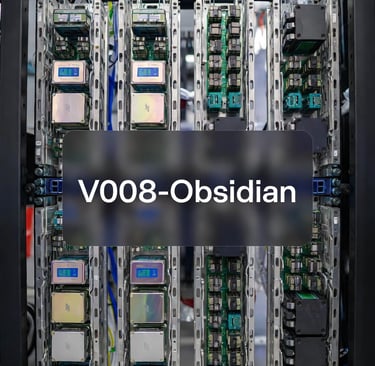
Primary Vector
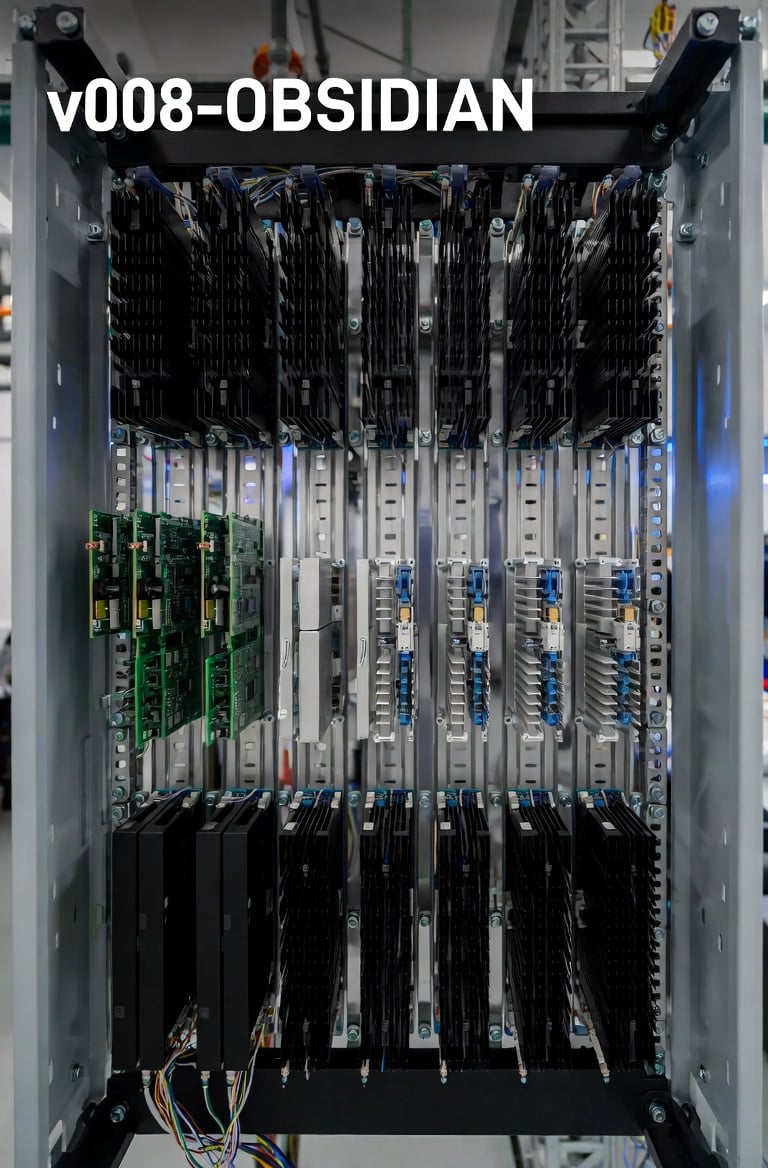
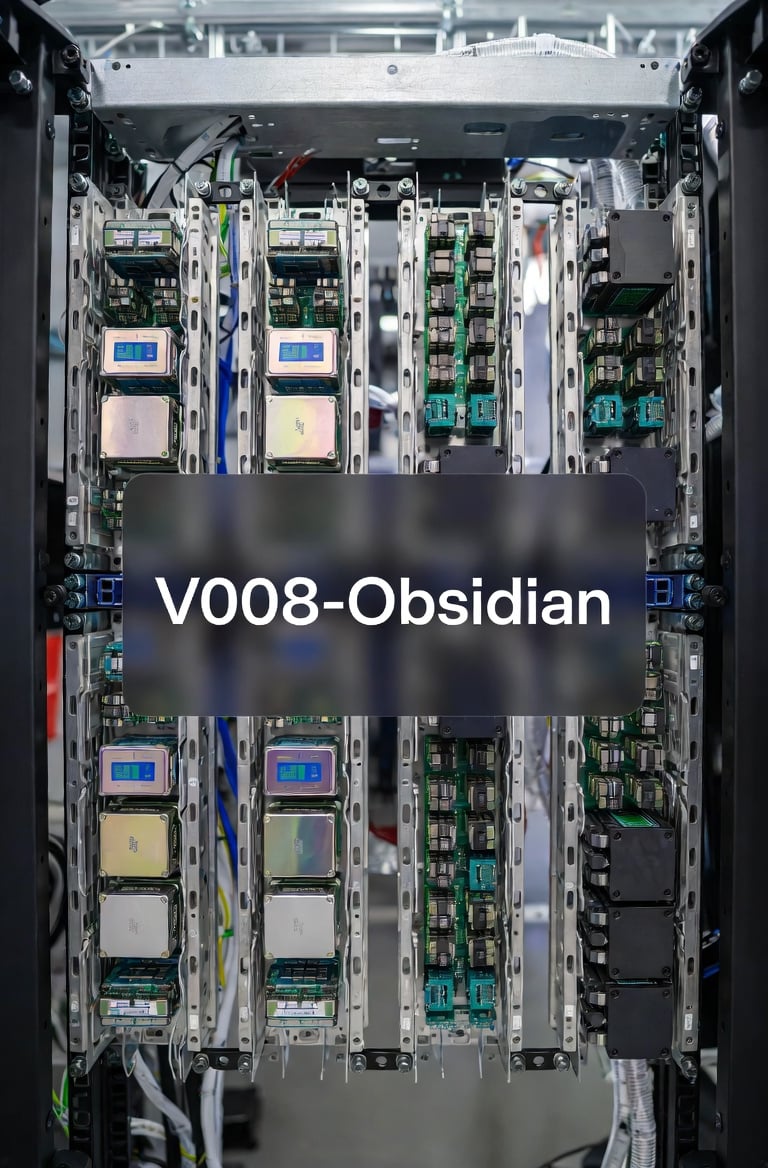
Sub-20ms deterministic power veto
Scope
Silicon, SiC, GaN (AI, power electronics)
What It Solves
Prevents irreversible lattice damage
Eliminates transient-induced fatigue
Enables high-density air operation (≥120kW/rack)
Why It Matters
v008 converts thermal risk from probabilistic to deterministic—a prerequisite for insurance underwriting.
Phase II — v009-RESIDIAN (Performance Recovery)
Thermal-Path Optimization
Primary Vector
Proprietary phase-locked lattice resonance
(details intentionally undisclosed)
Scope
Throttled high-performance systems
What It Solves
Reclaims 15–25% sustained performance lost to guard-band throttling
Expands air-cooling viability under governed conditions
Key Principle
v009 does not replace v008.
It amplifies governed systems already operating safely.
What We Do Not Disclose
Harmonic frequencies
Internal resonance maps
Geometry coefficients
Control kernels
This separation protects customers as much as it protects QH8.
A system that can be reverse-engineered cannot be a standard.
— THE TEL AVIV LAB
The Tel Aviv Sovereignty Audit
The Tel Aviv facility serves a single purpose:
To provide witnessed, insurer-grade validation of zero-water, air-governed operation.
What Is Demonstrated
Governed operation under elevated ambient conditions
Deterministic enforcement response times
Forensic receipt generation
Infrastructure decommissioning thresholds
Who Is Invited
Foundries
Hyperscalers
Insurers
Infrastructure regulators
This is not a marketing demo.
It is a sovereignty audit.
We do not fight physics. We enforce it.
# QH8 GOVERNANCE
Deterministic Thermal–Power Governance for High-Density Infrastructure
Status: Finalized Architecture Standard | Phase I Pilot Onboarding Open
1. The Industry Has Reached the Physical Wall
As of 2026, high-density compute infrastructure is no longer limited by average temperature or cooling capacity.
It is limited by millisecond-scale thermal and power transients inside lattice-based, stacked materials.
In 3D-ICs, HBM stacks, battery packs, power electronics, and grid hardware, these transients create indeterminate failure modes that cannot be resolved by:
- liquid cooling
- airflow optimization
- monitoring and alarms
- OEM telemetry
- post-event suppression
At densities above ~120 kW/rack, unmanaged vertical thermal gradients become structural risk, not operational variance.
Without deterministic vertical governance, these systems are physically ungovernable and increasingly uninsurable.
2. What QH8 Governance Is
QH8 provides a deterministic governance layer that governs whether energy is permitted to enter a material system before damage, ignition, or runaway can occur.
QH8 does not observe heat after it forms.
It governs eligibility to generate heat in the first place.
This governance operates on sub-20 ms time constants and produces immutable forensic records suitable for insurance, regulatory, and post-incident attribution.
3. What QH8 Governance Is Not
To avoid ambiguity:
- QH8 is not a cooling system
- QH8 is not HVAC, liquid cooling, or heat exchange
- QH8 does not eliminate thermodynamics
- QH8 does not override material limits
- QH8 does not promise performance uplift
QH8 governs risk boundaries, not physics itself.
4. The Governance Stack
QH8 operates as a layered, cumulative standard:
- v008-OBSIDIAN — Deterministic Enforcement
Prevents transient-induced failure by enforcing hard power and thermal boundaries before damage occurs.
- v009-RESIDIAN — Performance Recovery (Licensed / NDA)
Recovers efficiency lost to unmanaged thermal gradients while remaining inside certified safety envelopes.
- v010-DENSITY — Vertical Thermal Governance (Architectural Pre-Condition)
Pre-conditions stacked, vertical material systems so they remain governable at densities exceeding 200–300 kW/rack.
Without v010-class vertical governance, 3D-IC systems above 200 kW are structurally uninsurable.
5. Why Vertical Governance Is Now Mandatory
Modern infrastructure is moving vertically:
- 8–12 layer HBM stacks
- 3D-stacked AI accelerators
- Dense battery packs
- High-voltage power modules
Lateral heat dissipation cannot resolve inter-layer gradients in these systems.
Without deterministic vertical governance:
- failure modes become probabilistic
- attribution becomes impossible
- insurance coverage becomes conditional or excluded
QH8 v010 converts vertical stacks from liabilities into governable assets.
6. Insurability & Forensic Attribution
Every governed cycle produces a cryptographically sealed forensic receipt (SHA-256), independent of vendor logs or local hardware survival.
This enables:
- loss attribution without destroyed evidence
- distinction between wear-out and transient surge
- actuarial modeling of tail-risk
- defensible underwriting decisions
Systems without deterministic governance are black boxes of risk.
7. Material-Agnostic Scope (Licensed)
QH8 governance applies wherever uncontrolled heat accelerates degradation or ignition:
- AI silicon (2nm, 3D-IC, HBM)
- SiC / GaN power electronics
- energy storage systems
- grid and industrial infrastructure
Non-AI applications are available under licensing and NDA.
8. Regulatory & Insurance Position
QH8 does not replace engineering judgment.
It provides the minimum deterministic evidence required for:
- insurance underwriting
- regulatory review
- post-incident investigation
- risk transfer decisions
At extreme density, governance is no longer optional.
Final Statement
Infrastructure does not fail because it runs hot.
It fails because it runs ungoverned.
QH8 establishes the deterministic boundary between operable infrastructure and uninsurable risk.
© 2026 QH8 Technologies
U.S. Provisional Patents: 63/957,961 · 63/959,171
Details available under NDA