
⚖️ Industry Standard Compliance
The “Sovereign Audit” Questionnaire
Critical Risk Questions for High-Density Compute Infrastructure (2026)
I. Financial Governance & Asset Valuation
Focus: Balance sheet integrity, depreciation, CFO accountability, audit survival
Q1. Why does the absence of independent physical-state verification turn high-value GPUs into balance-sheet risk?
A. Without verifiable evidence of compliant operation, assets become “black boxes.” Silent degradation cannot be excluded, impairing resale value, collateral eligibility, and GAAP/IFRS depreciation assumptions.
Q2. Why is state discriminability now the most critical metric for CFO financial reporting?
A. If finance leadership cannot distinguish between healthy and silently degraded assets, valuation, impairment testing, and risk disclosure become unreliable and audit-fragile.
Q3. Why do ROI and depreciation models fail in high-density AI infrastructure without deterministic enforcement?
A. Silent fatigue consumes economic life invisibly. Without bounded physical states, depreciation reflects assumptions rather than evidence, leading to overstated ROI.
Q4. Why does AI infrastructure now carry balance-sheet risk comparable to financial instruments?
A. Asset value depends on provable condition over time. Without independent history, valuation, collateralization, and insurance fail simultaneously.
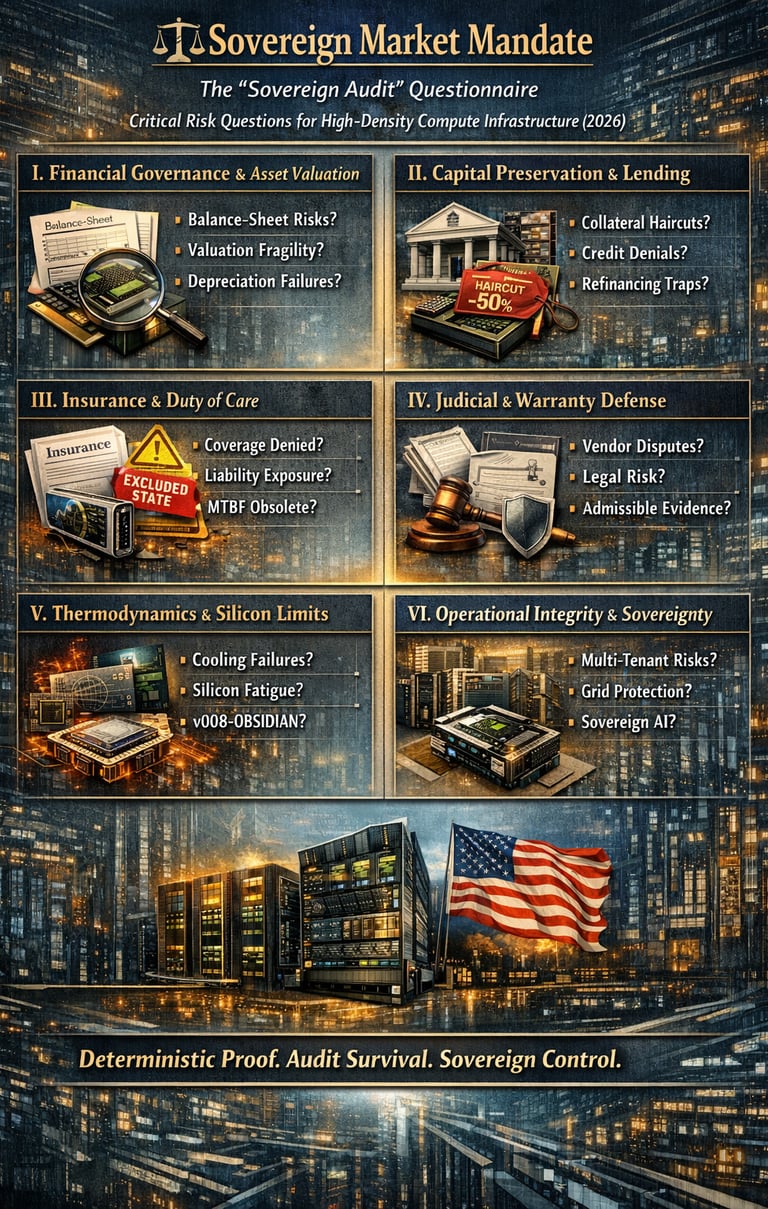
II. Capital Preservation & Lending
Focus: Debt facilities, collateral integrity, credit ratings, securitization
Q5. Why do lenders haircut unverified GPU collateral by 40–60% in 2026?
A. Banks reject vendor or operator telemetry as conflicted and assume worst-case silent degradation. Independent, tamper-evident provenance is required for bankability.
Q6. Why is independent verification required for hardware-backed lending to exist at scale?
A. Lenders cannot accept assets whose condition cannot be independently proven. Verified operating history restores liquidity and preserves loan-to-value ratios.
Q7. How does unverifiable degradation trap companies in refinancing deadlocks?
A. Assets lose collateral credibility, forcing higher rates, covenant breaches, or capital denial. Independent verification converts toxic liabilities back into financeable assets.
Q8. Why does increasing rack density eliminate tolerance for ungoverned operation in credit markets?
A. At extreme density, a single transient can destroy collateral value. Credit markets now require deterministic exclusion of unsafe physical states.
III. Insurance, Actuarial Risk & Duty of Care
Focus: Coverage eligibility, exclusions, negligence exposure, executive liability
Q9. Why are insurers conditioning coverage on verification rather than monitoring?
A. Monitoring observes outcomes; insurers require proof that excluded regimes were never entered. Independent enforcement converts ambiguity into insurable behavior.
Q10. What happens when an insurer determines an asset entered an “excluded state”?
A. Coverage is denied under operational-abuse or gradual-degradation clauses, leaving the operator with 100% retained liability.
Q11. Why is traditional MTBF no longer a valid reliability metric for high-density AI assets?
A. MTBF measures visible failure, not cumulative physical degradation. Independent state compliance replaces probabilistic metrics with admissible evidence.
Q12. Why is “duty of care” compliance impossible without a published independent mandate?
A. In regulated or sovereign environments, best-effort cooling or self-certification is negligent. Duty of care now requires documented, preventive governance.
IV. Judicial, Warranty & Evidentiary Defense
Focus: Litigation, warranty claims, bankruptcy, M&A disputes
Q13. Why is self-certification by hardware manufacturers no longer legally defensible?
A. A manufacturer is a financially interested party and cannot act as defendant, witness, and arbiter simultaneously. Courts increasingly reject vendor-controlled telemetry.
Q14. Why are OEM telemetry logs insufficient for warranty and insurance disputes?
A. They are vendor-controlled, mutable, and non-adversarial. Independent, cryptographically sealed records are required for admissibility.
Q15. How does independent verification resolve operator–vendor “he-said/she-said” disputes?
A. Deterministic records show whether enforced limits were respected at the time of failure, enabling immediate liability attribution.
Q16. Why do M&A processes and restructurings collapse over “undisclosed fatigue”?
A. Without verified operating history, buyers and trustees assume abuse or overstatement, triggering escrows, repricing, or deal failure.
V. Thermodynamics & Physics of Silicon Failure
Focus: HBM4, micro-transients, fatigue, physical limits
Q17. Why isn’t liquid cooling sufficient at extreme power density?
A. Liquid cooling reacts on second-scale time constants, while critical silicon damage occurs in sub-20ms windows beyond its reach.
Q18. Why can’t cooling resolve the HBM4 middle-layer heat trap?
A. Liquid only touches surfaces. In 16-high stacks, entropy accumulates internally where no coolant reaches, causing invisible degradation.
Q19. What problem does v008-OBSIDIAN actually solve?
A. It enforces silicon-safe operating boundaries in real time, preventing entry into damage-causing physical states before cooling or telemetry can react.
Q20. Why is “average operating temperature” a misleading metric for silicon longevity?
A. Averages mask gradients and transients that drive fatigue, electromigration, and delamination. Longevity depends on peak physical states.
VI. Operational Integrity, Sovereignty & Continuity
Focus: Multi-tenant clouds, facilities, grids, national infrastructure
Q21. Why is deterministic enforcement required in multi-tenant environments?
A. Tenants control workloads, not hardware. Non-bypassable physical enforcement is required to prevent abuse without inspecting tenant code.
Q22. How does independent enforcement enable tenant and event attribution?
A. Enforcement events are time-indexed and cryptographically verifiable, correlating hardware stress to execution windows without IP exposure.
Q23. How does deterministic enforcement protect facilities and power grids?
A. By clamping transients before they propagate upstream, preventing breaker trips, cascading outages, and utility violations.
Q24. Why is independent governance indispensable for sovereign AI and 2,000W+ transitions?
A. As margins collapse, ungoverned operation becomes existential risk. Sovereign duty of care requires deterministic, vendor-neutral enforcement and evidence.
Copyright © 2026 QH8 Technologies
Contact us at contact@qh8technologies.com
📜 Underwriter Fact Sheet (PDF)
🛡️ v008-OBSIDIAN Sovereign Spec Sheet. (PDF)