
QH8 Technologies — Technical Notes & Operating Effects
Scope of Disclosure
QH8 Technologies provides deterministic thermal–power governance for high-density AI silicon.
This page documents observed operating effects and stabilization outcomes resulting from enforced physics-derived limits.
QH8 does not manufacture cooling hardware and does not replace facility thermal infrastructure.
All effects described below depend on workload, environment, and enforcement configuration.
v008-OBSIDIAN — Observed Operating Effects
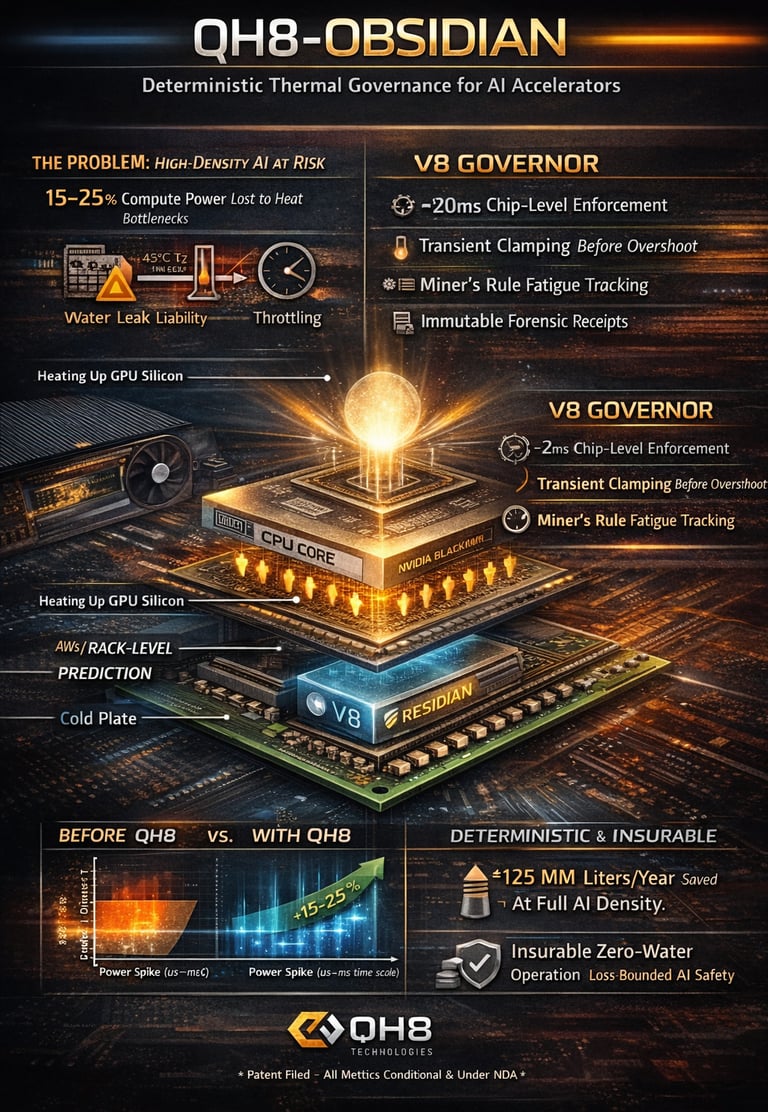
In governed deployments of 1,000–1,500W-class AI accelerators, the v008-OBSIDIAN enforcement engine has demonstrated:
Junction temperature stabilization under transient power conditions
Prevention of OEM thermal overshoot during sub-thermal-timescale power spikes
Observed junction temperature reductions on the order of ~15°C–20°C under controlled operating conditions, relative to ungoverned operation
These effects arise from deterministic enforcement of power and thermal boundaries prior to runaway, rather than increased heat removal capacity.

This page is intended as a technical disclosure. It does not constitute a performance guarantee or a substitute for facility thermal design.
Governance References
Enforcement Engine: v008-OBSIDIAN
Enforcement latency: sub-20 ms
Audit artifact: Sovereign Enforcement Receipt (SHA-256 chained)
Patent status: U.S. and international applications pending
Observed effects are derived from internal test and governed deployment data and are provided for technical transparency.
Relevance to Reliability and Attribution
At high TDP, silicon degradation is often driven by cumulative
thermal fatigue caused by repeated transient excursions rather than steady-state temperature alone.
By enforcing deterministic operating limits and recording enforcement actions, QH8 enables:
Reduced cumulative thermal stress
Improved post-event attribution for warranty and insurance analysis
Objective, tamper-evident evidence of compliant operation
Interpretation Notes
The values above represent observed stabilization effects, not guaranteed outcomes
QH8 governs operating behavior; cooling performance remains dependent on infrastructure
Results vary by workload profile, ambient conditions, and enforcement configuration
QH8 does not claim universal temperature reduction across all deployments
This disclosure is provided for technical transparency and attribution clarity.