
OUR TECHNOLOGY
independent thermal–power governance authority
We design deterministic enforcement systems that operate outside OEM firmware to
govern how high-density silicon is allowed to operate after deployment — not just how it was designed to perform in controlled conditions.
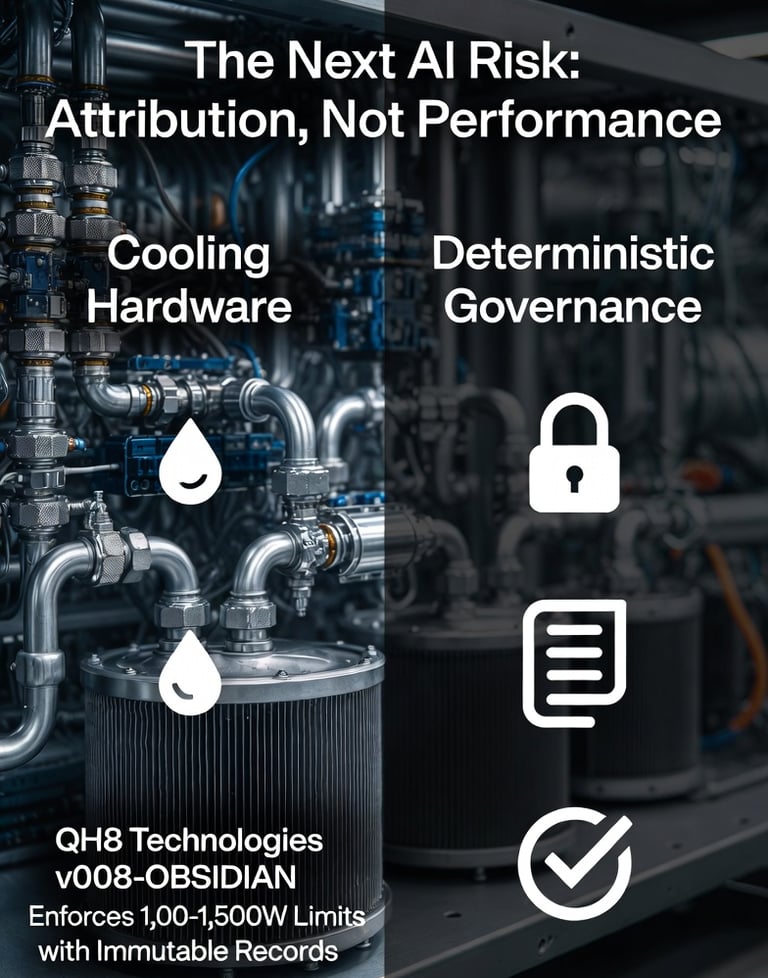
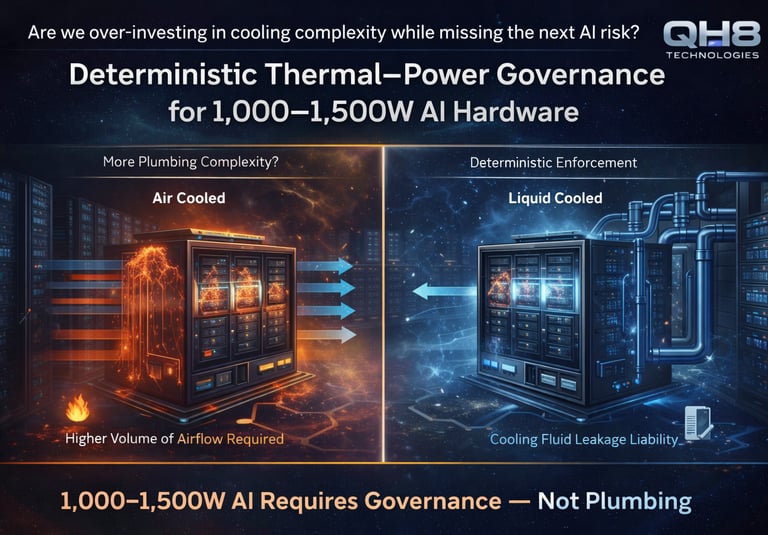
As AI accelerators push beyond 1,000–1,500W TDP, many of the most costly failures are no longer performance-related. They are attribution failures: situations where it becomes impossible to prove whether damage resulted from silicon limits, firmware behavior, cooling assumptions, or operational misuse.
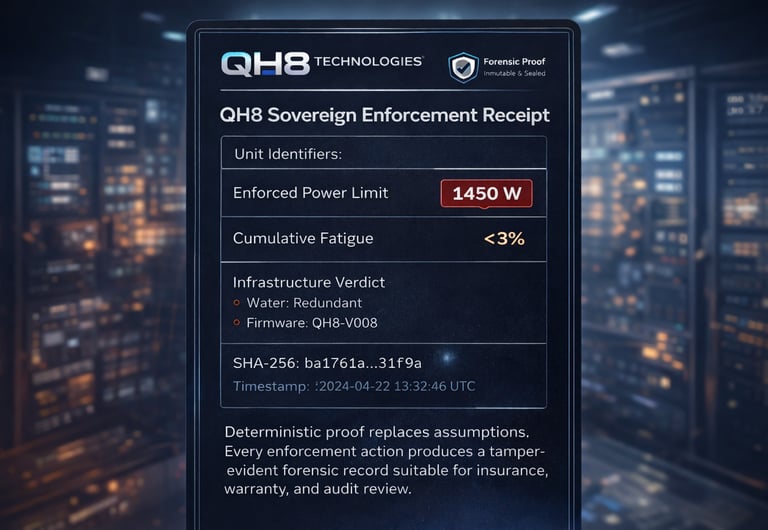
QH8 addresses this gap by enforcing physics-derived operating limits in real time and generating immutable forensic records that document exactly how hardware was governed in production.
Our systems provide decision-grade evidence for operators, insurers, and compliance teams — transforming thermal and power risk from an assumption into a verifiable, auditable control layer.
QH8 does not manufacture hardware, cooling equipment, or monitoring dashboards.
We provide independent operating authority.
When performance scales faster than accountability, governance becomes infrastructure.
Operational Evidence
Verifiable artifacts produced by live, independent thermal–power enforcement on AI hardware
Copyright © 2026 QH8 Technologies
Contact us at contact@qh8technologies.com
📜 Underwriter Fact Sheet (PDF)
🛡️ v008-OBSIDIAN Sovereign Spec Sheet. (PDF)