OT Physical Validation
QH8 adds physical-layer evidence to help compare reported digital control states against actual equipment behavior.
Insurance, Warranty & Audit Support
QH8 strengthens the operating record by connecting telemetry, timestamps, disturbance history, and technical findings into a clearer evidence package.
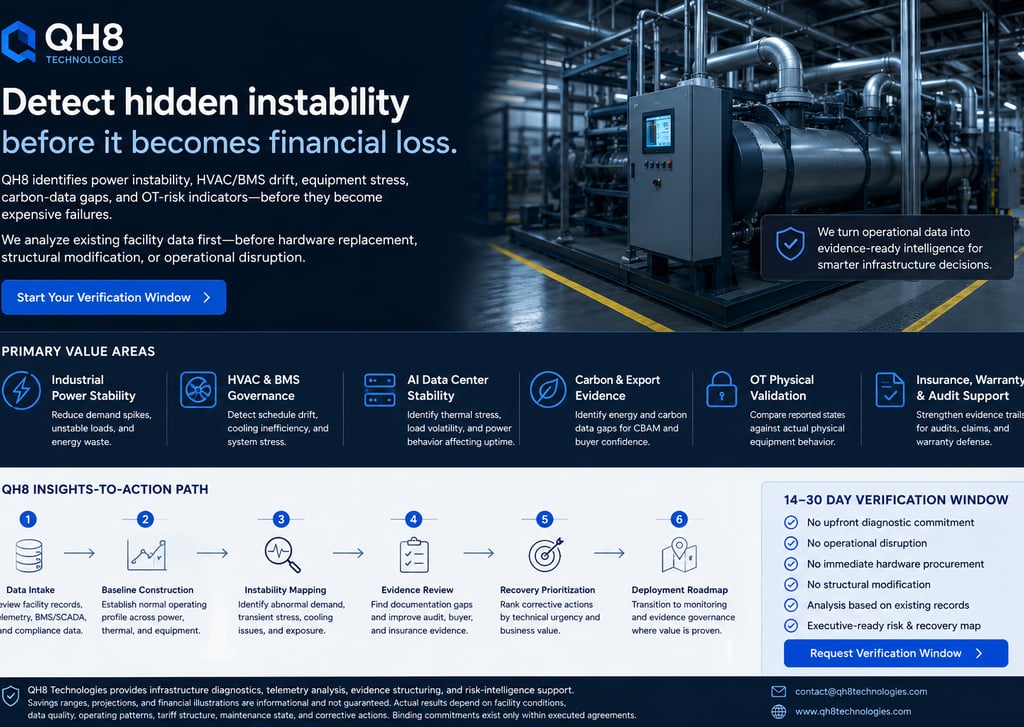
14-30 Day Verification Window
QH8 can begin with a short diagnostic window using real facility records before full deployment.
This phase is designed to provide:
No upfront diagnostic commitment
No operational disruption
No immediate hardware procurement
No structural modification
Executive-ready risk and recovery prioritiesQH8 Insights-to-Action Path
1. Data Intake
QH8 reviews available facility records, energy data, BMS/SCADA exports, telemetry, maintenance history, and compliance documentation.
2. Baseline Construction
We establish the facility’s normal operating profile across power, thermal, equipment, and operational behavior.
3. Instability Mapping
We identify abnormal demand patterns, transient stress, inefficient sequencing, cooling instability, and equipment exposure.
4. Evidence Review
We identify where documentation is strong, where data is weak, and where audit, buyer, insurance, or warranty evidence can improve.
5. Recovery Prioritization
QH8 ranks corrective actions by technical urgency and commercial value.
6. Deployment Roadmap
Where value is proven, QH8 can transition from diagnostic review to continuous physical-layer monitoring and evidence governance.
Executive Outputs
At the end of the verification window, QH8 can provide:
Disclaimer
QH8 Technologies provides infrastructure diagnostics, telemetry analysis, evidence structuring, and risk-intelligence support.
Savings ranges, projections, and financial illustrations are informational and not guaranteed. Actual results depend on facility conditions, data quality, operating patterns, tariff structure, maintenance state, and corrective actions. Binding commitments exist only within executed agreements.
Operational instability map
Energy-waste and demand-risk profile
HVAC/BMS drift assessment
Equipment stress and pre-failure indicators
CBAM or carbon-data readiness findings
OT physical-behavior anomaly summary
Financial recovery estimate
Corrective-action roadmap
The goal is to answer one question clearly:
Where is the facility losing value, and what should be fixed first?
Why QH8
QH8 gives operators infrastructure intelligence before infrastructure spending.
We help facilities make decisions based on physical evidence rather than dashboards, estimates, or disconnected reports.
Secure Your Verification Window
QH8 Technologies works with industrial facilities, AI data centers, commercial property portfolios, infrastructure owners, exporters, and OT-risk teams that need measurable operational intelligence before committing to major infrastructure changes.
Infrastructure Diagnostics
& Risk Optimization
Detect hidden instability before
it becomes financial loss.
QH8 Technologies helps infrastructure operators identify power instability, HVAC/BMS drift, equipment stress, carbon-data gaps, and physical OT-risk indicators before they become expensive failures.
We analyze existing facility data first — before hardware replacement, structural modification, or operational disruption is required.
The output is a concise risk and recovery map showing where value is leaking, where exposure is concentrated, and what should be fixed first.
The Invisible Tax of Instability
Infrastructure instability behaves like an invisible tax.
It appears as higher utility bills, peak-demand charges, unnecessary runtime, equipment wear, emergency maintenance, compliance weakness, and avoidable CapEx.
QH8 reviews available operational evidence — including utility records, interval energy data, BMS/SCADA exports, production logs, maintenance records, and equipment runtime history — to identify:
Demand spikes and peak-load exposure
Power instability, transient stress, and unstable loads
HVAC/BMS schedule drift and cooling-loop inefficiency
Equipment stress and pre-failure degradation signatures
Weak carbon-data records or gaps in audit, warranty, insurance, or buyer documentation
Mismatches between reported digital states and actual physical behavior
QH8 does not begin by asking the operator to replace infrastructure.
We begin by proving where the infrastructure is already leaking value.
Primary Value Areas
Industrial Power Stability
QH8 identifies demand spikes, inefficient sequencing, transient stress, and unstable loads that increase operating cost or equipment risk.
HVAC & BMS Governance
QH8 detects setpoint drift, schedule conflicts, cooling-loop inefficiency, pump stress, chiller stress, and building-system behavior that increases waste or reliability risk.
AI Data Center Stability
QH8 supports high-density infrastructure by identifying load volatility, thermal stress, cooling inefficiency, and electrical behavior that may affect uptime or equipment life.
Carbon & Export Evidence
For industrial exporters, QH8 helps identify energy and carbon-data gaps that may affect CBAM readiness, buyer confidence, or supply-chain review.