Your blog post
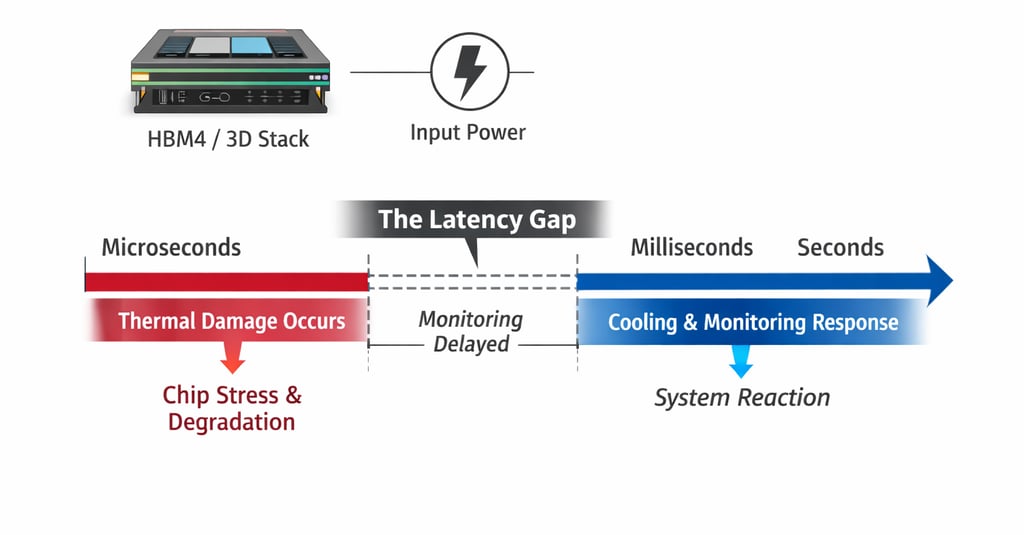
The 1,500-Watt Wall: Why AI Infrastructure Is Becoming a Balance-Sheet Risk As the AI industry accelerates toward next-generation accelerators drawing 1,500 to 2,000 watts per device, a new risk is emerging that has little to do with software performance and everything to do with asset value. For banks, insurers, and private equity firms funding large-scale AI deployments, the core concern is no longer access to GPUs. It is the ability to verify their physical condition over time. Across financial markets, analysts are beginning to flag a growing blind spot in high-density compute: hardware that appears healthy at the software level may be accumulating irreversible physical degradation well before traditional monitoring systems register a fault. This disconnect is increasingly influencing credit terms, insurance coverage, and secondary-market pricing. When a GPU Stops Being an Asset A GPU priced at $30,000 to $40,000 only retains value if its condition can be independently substantiated. In practice, most AI infrastructure today still operates as a “black box” from a financial standpoint. Operators report utilization and uptime, but they cannot always demonstrate whether the silicon has remained within safe physical limits throughout its operational life. This issue becomes acute with the industry’s shift toward HBM4 memory and vertically stacked, 3D-IC architectures. These designs deliver higher performance by increasing proximity between logic and memory, but they also narrow thermal and electrical margins. Damage mechanisms can be triggered by short, high-intensity power or thermal excursions that occur faster than conventional cooling systems or firmware throttles can reliably respond. The result is a growing class of assets whose book value assumes a multi-year lifespan, while lenders and insurers quietly model a much shorter effective life due to unverifiable wear. From Operational Risk to Financial Exposure The implications are already visible in financial decision-making. Lenders are beginning to apply steeper haircuts to GPU collateral when independent verification is absent. Insurance policies issued in 2026 increasingly contain exclusions for gradual degradation unless operators can produce continuous, auditable evidence of compliant operation. In private equity transactions, due-diligence teams are discounting AI infrastructure aggressively when asset health cannot be substantiated. Secondary markets reflect the same logic. Used GPUs with no verifiable operational history often trade at significant discounts, not because they are non-functional, but because buyers must assume worst-case abuse in the absence of proof. In this environment, monitoring dashboards and vendor telemetry are no longer sufficient. They describe performance, not physical condition, and they are typically self-reported by the party bearing liability. The Shift From Monitoring to Governance In response, a new category of infrastructure control is emerging: physical-state governance. Rather than observing failures after they occur, governance systems enforce safe operating boundaries in real time and generate immutable records of compliance. Frameworks developed by companies such as QH8 Technologies describe how independent verification of physical operation is becoming a prerequisite for asset bankability. These approaches emphasize out-of-band enforcement and cryptographically sealed operational records that can be reviewed by lenders, insurers, auditors, and courts without reliance on vendor interpretation. The distinction matters. From a financial perspective, an AI cluster is no longer valued solely on its peak performance, but on whether its remaining useful life can be credibly demonstrated. A New Fiduciary Standard As accelerator power continues to rise, the industry is approaching what some financiers describe as the “1,500-watt wall”—the point at which unmanaged physical risk becomes material to balance sheets. For executives, this represents a shift in fiduciary responsibility. The question is no longer simply whether AI infrastructure is fast or available, but whether its operation can be defended under scrutiny from insurers, regulators, and capital markets. In the high-density era, independent verification of physical condition is moving from a technical consideration to a financial requirement. Assets that cannot be verified are increasingly treated not as infrastructure, but as contingent liabilities.
1/30/20261 min read