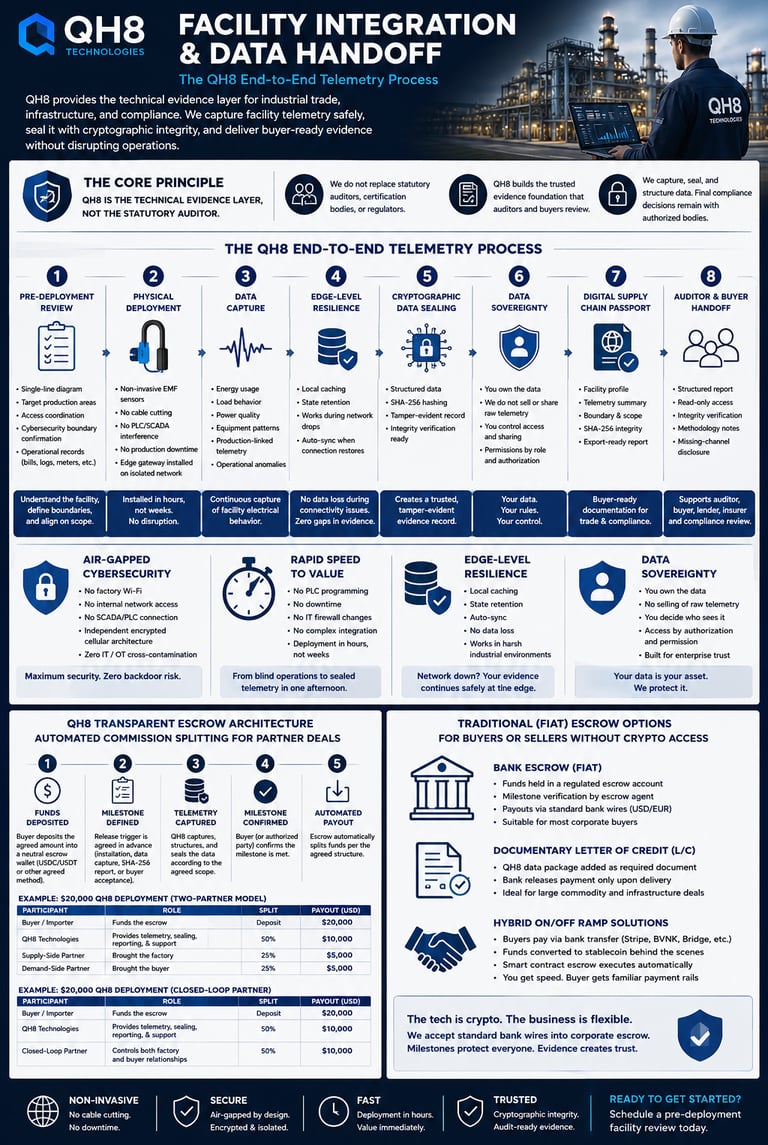
1. Pre-Deployment Review
What the Facility Provides
Before any technical deployment, QH8 conducts a basic pre-deployment review with the facility team.
The goal is not to disrupt operations. The goal is to understand the electrical layout, target production areas, cybersecurity boundaries, and evidence requirements.
The facility typically provides the following.
Single-Line Diagram
A basic electrical single-line diagram or equivalent layout showing the main distribution paths, switchgear, transformers, feeders, and major load groups.
This helps QH8 identify safe telemetry points.
Target Production Areas
The facility identifies which production lines, furnaces, compressors, chillers, kilns, mills, battery systems, or process areas are commercially relevant.
For example, the target may be a steel production line, cement grinding process, fertilizer production zone, battery material line, cooling plant, or high-density electrical load.
Access Coordination
The facility provides supervised access to the relevant electrical rooms, switchgear areas, distribution boards, or metering locations.
All access is coordinated with the facility’s safety and engineering team.
Cybersecurity Boundary Confirmation
Before deployment, QH8 confirms the facility’s cybersecurity requirements.
This includes whether the facility requires:
No connection to corporate Wi-Fi
No connection to internal LAN
No access to SCADA command systems
No PLC integration
No inbound remote access
Separate cellular transmission
Offline export of data where required
Local IT or CISO review before activation
QH8’s default approach is to avoid the facility’s internal IT and OT networks unless the client explicitly approves a different configuration.
Available Operational Records
Where available, QH8 may review supporting documents such as:
Utility bills
Existing meter data
Production logs
Export batch records
Maintenance records
Energy invoices
Shift schedules
Equipment lists
Existing audit reports
These records help establish context for the telemetry.
2. Physical Deployment
What QH8 Does On-Site
QH8’s deployment approach is designed around operational safety, cybersecurity separation, and minimal interference.
Non-Invasive Installation
QH8 does not cut cables, splice wires, open live circuits, or modify production machinery.
The system uses contactless EMF-based telemetry to observe electrical behavior from existing power feeds.
No PLC or SCADA Interference
QH8 does not rewrite control logic, alter automation programs, or connect directly into PLC or SCADA command functions.
The system is designed to observe, not control.
QH8 does not send commands to production equipment.
No Planned Production Downtime
Because QH8 does not break the electrical circuit or interrupt the production process, deployment can typically be performed without stopping the facility.
All installation activity remains subject to site safety rules, electrical access approvals, and local engineering procedures.
Network-Isolated Edge Gateway
Where required, QH8 installs a secure edge gateway to collect and transmit telemetry.
The gateway can operate independently from the facility’s internal IT and OT networks.
QH8 does not require factory Wi-Fi passwords, corporate intranet access, or connection to internal SCADA infrastructure.
The standard architecture can use a separate encrypted cellular connection or another approved isolated communication method, depending on site policy and local network conditions.
This reduces cybersecurity friction and helps prevent third-party telemetry equipment from becoming a bridge into sensitive internal systems.
Rapid Speed to Value
Because QH8 does not require PLC programming, machinery shutdown, IT firewall reconfiguration, or major electrical modification, a standard node deployment can often be completed in hours, not weeks, depending on site access, safety approvals, and deployment scope.
The objective is simple:
Move from limited visibility to structured telemetry with minimal operational burden.
3. Data Capture
What QH8 Measures
Once installed, QH8 begins building an operational picture of the facility’s electrical behavior.
Depending on the deployment scope, the system can help capture and analyze:
Energy consumption patterns
Peak-demand events
Load behavior
Baseload waste
Power-factor issues
Harmonic distortion
Cooling-related electrical stress
Equipment load sequencing
Production-linked energy intensity
Time-based operational anomalies
Capacity losses caused by poor electrical behavior
For EU-facing supply chains, this telemetry can support stronger documentation for CBAM readiness, Digital Battery Passport preparation, buyer due diligence, and supply-chain data requests.
For European infrastructure projects, the same data can support grid-capacity analysis, investor evidence, tenant reporting, insurance review, and energy-performance documentation.
4. Edge-Level Resilience
What Happens If the Network Drops
Industrial environments are difficult for wireless communication.
Factories, steel structures, switchgear rooms, basements, reinforced concrete, and heavy machinery can weaken or interrupt external connections.
QH8 is designed with this reality in mind.
If the external connection drops, the telemetry process does not automatically lose the production record.
The QH8 edge node can use local caching and state retention to continue holding operational telemetry at the edge until the connection is restored.
Once the approved connection becomes available again, the system can reconcile and sync the stored records according to the deployment configuration.
This helps reduce evidence gaps caused by temporary connectivity failures.
The goal is to preserve continuity of the operational record even when the external network is unstable.
5. Cryptographic Data Sealing
Creating a Tamper-Evident Evidence Record
Raw telemetry has limited value unless it can be trusted.
QH8 converts operational data into structured evidence records and seals them using SHA-256 cryptographic hashing.
This creates a tamper-evident record of the dataset.
If the underlying data is changed after sealing, the hash will no longer match. This provides a clear integrity check for auditors, buyers, lenders, insurers, and internal compliance teams.
QH8 evidence packages may include:
Facility profile
Deployment scope
Metering boundary
Timestamped telemetry records
Energy consumption summary
Production-linked data where available
Missing-channel disclosures
SHA-256 dataset hash
Report generation timestamp
Technical methodology notes
Audit handoff summary
The purpose is not to claim that QH8 replaces official verification.
The purpose is to give official reviewers a stronger, cleaner, and more traceable evidence package.
6. Data Sovereignty
The Facility Owns Its Raw Telemetry
QH8 acts as a secure telemetry, evidence-structuring, and cryptographic integrity layer.
The facility remains the owner of its underlying operational data.
QH8 does not sell raw facility telemetry, production baselines, or operational metrics to unauthorized third parties.
The facility controls which buyer, auditor, lender, insurer, compliance team, or commercial counterparty receives access to the structured evidence package.
Access can be controlled through written authorization, report-level permissions, read-only exports, or other agreed data-sharing procedures.
This is critical for industrial operators.
A factory’s energy profile, production behavior, load patterns, and equipment usage are commercially sensitive. QH8 treats that data as controlled operational evidence, not as a public dataset.
7. Digital Supply Chain Passport
Turning Facility Data Into Buyer-Ready Documentation
For industrial exporters, QH8 can help convert facility telemetry into a Digital Supply Chain Passport or technical evidence package.
This document can support commercial discussions with:
European importers
Procurement teams
Trade-finance banks
Insurance underwriters
Infrastructure investors
CBAM advisors
Battery supply-chain teams
Statutory auditors
Certification bodies
The QH8 evidence package can help answer practical buyer questions:
Where was the product produced?
Which facility or line was involved?
What energy data supports the production claim?
What telemetry boundary was measured?
What data was available?
What data was not instrumented?
Has the dataset been sealed?
Can the integrity of the report be checked?
Who is authorized to view the evidence?
This makes the supplier easier to evaluate and the buyer’s documentation process more defensible.
8. Auditor and Buyer Handoff
How QH8 Supports the Review Process
When a buyer, auditor, lender, insurer, or compliance team needs to review the evidence, QH8 can support the handoff process.
Depending on the agreement, QH8 may provide the following.
Structured Technical Report
A clear report summarizing the facility, telemetry scope, measurement period, data boundary, key findings, and integrity records.
Read-Only Evidence Access
Where appropriate, reviewers can be given controlled access to relevant evidence records or exported datasets.
SHA-256 Integrity Verification
Reviewers can verify that the dataset associated with the report has not been silently altered after sealing.
Methodology Explanation
QH8 can explain how the telemetry was collected, what was measured, what was excluded, and how the evidence package was generated.
Missing-Channel Disclosure
If certain equipment, process areas, or data channels were not measured, QH8 identifies those boundaries instead of pretending the dataset is complete.
This is important for credibility.
Strong evidence does not mean hiding uncertainty. It means making the data boundary clear.
9. What QH8 Does Not Do
For clarity, QH8 does not:
Issue statutory audit opinions
Replace official CBAM verification bodies
Replace customs brokers
Provide legal tax advice
Certify emissions independently as a regulator
Override facility engineering procedures
Control production equipment
Modify PLC or SCADA logic
Require access to internal Wi-Fi by default
Require access to corporate intranet by default
Guarantee customs outcomes
Guarantee buyer acceptance without review
QH8 provides technical telemetry, data integrity, evidence structuring, and audit-support documentation.
Final compliance decisions remain with the relevant buyer, auditor, regulator, bank, insurer, or statutory authority.
10. Why This Matters
Factories and infrastructure operators are under pressure to prove more with better data.
Manual spreadsheets, disconnected records, and unverified utility summaries are often not enough for modern procurement, financing, insurance, and compliance review.
QH8 helps operators move from weak documentation to structured operational evidence.
For exporters, this can strengthen buyer confidence.
For infrastructure developers, it can support financing and grid-capacity discussions.
For data centers and energy-intensive facilities, it can support uptime, power-use transparency, tenant reporting, and insurance review.
For factories, it can expose hidden energy waste and improve the quality of operational reporting.
11. The QH8 Deployment Path
A typical QH8 deployment follows a simple sequence:
Facility review
Cybersecurity boundary confirmation
Electrical boundary identification
Target line or load selection
Non-invasive telemetry deployment
Edge gateway configuration
Data capture period
Local caching and sync validation
Operational analysis
SHA-256 sealing
Technical evidence package generation
Buyer, auditor, lender, insurer, or investor handoff
Expansion if the pilot proves value
The process is designed to start small, prove value, and scale only where the commercial case is clear.
Your facility is already producing valuable operational data.
The problem is that most of it is not captured, structured, sealed, protected, or prepared for external review.
QH8 helps turn facility telemetry into defensible evidence for industrial trade, infrastructure finance, buyer due diligence, and compliance support.
We do this without interfering with production systems, without rewriting control logic, and without requiring access to your internal IT network by default.
QH8 Technologies provides the technical evidence layer between the factory floor and the commercial decision-maker.
Schedule a pre-deployment facility review.
Facility Integration & Data Handoff
The QH8 End-to-End Telemetry Process
Industrial operators cannot afford disruption.
A steel mill, cement plant, battery facility, mining operation, data center, or energy-intensive factory cannot stop production just to install another monitoring system. Any external technology must respect uptime, safety procedures, electrical boundaries, cybersecurity requirements, and existing control systems.
That is why the QH8 deployment model is designed to be non-invasive, network-isolated, and evidence-focused.
QH8 does not rewrite PLC logic, interfere with SCADA systems, modify production equipment, or require planned downtime. Our role is to capture operational telemetry safely, structure it into defensible evidence, and prepare it for review by buyers, auditors, lenders, insurers, and compliance teams.
The Core Principle
QH8 Is the Technical Evidence Layer, Not the Statutory Auditor
QH8 is not a statutory audit firm, customs authority, certification body, or legal compliance advisor.
We do not replace organizations such as TÜV, SGS, Bureau Veritas, DNV, Big Four advisory teams, customs brokers, or official CBAM verifiers.
QH8 provides the technical evidence layer underneath the audit and compliance process.
Many factories already generate the data that buyers and auditors need. The problem is that this data is often scattered across utility bills, manual spreadsheets, incomplete meter readings, production logs, disconnected systems, and undocumented assumptions.
QH8 helps solve that problem by capturing facility-level telemetry, sealing the data with cryptographic integrity records, and converting the output into structured technical documentation.
This gives official auditors and commercial counterparties a stronger evidence base to review.