
Infrastructure Integrity
Diagnostics & Telemetry
Delivering condition-based
monitoring and equipment
degradation analytics for heavy
industry and advanced compute.
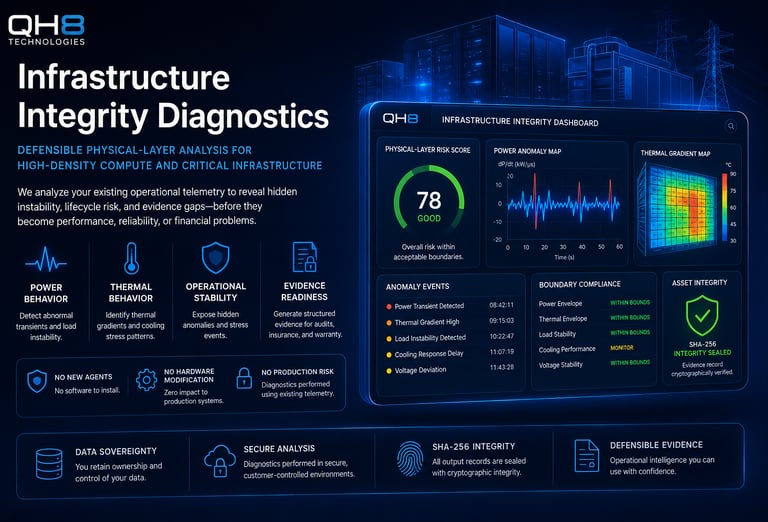
Defensible physical-layer analysis for high-density compute and critical infrastructure.
Infrastructure failure rarely begins as a visible outage.
It usually begins earlier in the physical layer: transient power behavior, thermal instability, abnormal load patterns, cooling stress, and evidence gaps that standard dashboards may not expose clearly.
QH8 Technologies analyzes existing operational telemetry and converts it into structured physical-layer intelligence, helping asset owners identify hidden instability, lifecycle risk, and evidence gaps before they become financial, operational, warranty, or insurance problems.
The Visibility Gap: Status vs. Integrity
Standard monitoring systems report basic status: whether equipment is online, whether thresholds were crossed, and whether alerts were triggered.
That is useful, but it does not always prove whether infrastructure is physically healthy.
Critical asset risk can develop underneath dashboards through:
Short-duration power transients
Thermal gradients
Cooling-loop imbalance
Repeated stress cycles
Load volatility
Hidden mechanical degradation indicators
QH8 closes this gap by showing where infrastructure is accumulating stress, drifting from stable operation, or creating evidence gaps.
What QH8 Diagnoses
Power Behavior
Load transitions, transients, abnormal power patterns, and electrical instability.
Thermal Behavior
Heat movement, cooling response, thermal drift, and boundary stress.
Operational Stability
Anomaly events, stress indicators, operating variation, and lifecycle signals.
Evidence Readiness
Structured records for technical review, insurance, warranty, audit, and executive reporting.
Zero-Friction Core Diagnostic
The QH8 Infrastructure Integrity Diagnostic is a structured review of existing telemetry and operating records.
It is designed to identify physical-layer risk without disrupting production systems.
QH8 diagnostics can be performed with:
No production shutdown
No change to customer workloads
No access to source code, AI models, or tenant data
No unnecessary interference with existing monitoring systems
Diagnostic Workflow
Data Intake
Telemetry, logs, or monitoring exports are securely provided or connected.Physical-Layer Analysis
QH8 evaluates power, thermal, load, anomaly, and lifecycle signals.Integrity Review
Evidence gaps, unstable patterns, and review conditions are identified.Report Generation
Outputs are prepared for technical teams, executives, insurers, auditors, or asset managers.Optional Asset Passport
Diagnostic outputs can become a lifecycle evidence record.
What You Receive
A QH8 Infrastructure Integrity Diagnostic may include:
Physical-layer risk map
Power and thermal behavior review
Anomaly and stress event summary
Boundary and lifecycle-risk review
SHA-256 integrity-sealed evidence record where applicable
Executive infrastructure brief
Optional QH8 Asset Passport path
Secure Data Handling
Customers retain ownership and control of operational data.
Diagnostics can use restricted datasets, secure transfer workflows, private environments, or customer-controlled storage.
SHA-256 verification can preserve output integrity without exposing raw operational data publicly.
Who This Is For
AI Data Centers
GPU clusters, dense racks, cooling systems, and electrical infrastructure where thermal and power instability affect uptime and asset life.
Energy Infrastructure
Inverters, batteries, transformers, distribution assets, and grid-connected systems requiring lifecycle evidence.
Industrial Facilities
Factories and heavy assets where equipment behavior, power quality, and physical stress affect cost and reliability.
Investors and Insurers
Underwriters, asset owners, lenders, and risk committees that need stronger operating evidence.
Request an Infrastructure Integrity Diagnostic
Submit infrastructure telemetry, operational logs, or asset records for review.
QH8 will analyze the available data and generate a structured diagnostic report showing physical-layer behavior, anomaly patterns, lifecycle signals, and evidence-readiness status.
Disclaimer
QH8 Technologies provides technical diagnostic, analytical, telemetry-review, evidence-structuring, and infrastructure-governance services for informational and evaluation purposes only. Results depend on facility conditions, data quality, operating behavior, equipment condition, and corrective actions. QH8 does not guarantee savings, recovery ranges, compliance approval, insurance outcomes, audit acceptance, regulatory determinations, or operational results. Binding commitments exist only within executed written agreements.
Transient power spike detection
Equipment thermal stress analysis
Facility load instability detection
BMS logic drift detection
Cooling imbalance and boundary deviations
Stress-cycle accumulation over time
Physical-Layer Infrastructure Telemetry
Condition-Based Monitoring
Equipment Degradation Monitoring