
CBAM Trade Governance
Reduce CBAM Exposure with Verified Industrial Data
QH8 Technologies helps EU-facing exporters, importers, industrial suppliers, and capital partners reduce CBAM risk through operational energy optimization, hardware-anchored telemetry, and cryptographically sealed evidence.
CBAM is changing industrial trade.
For exporters, delivering the physical material is no longer enough. Companies must now prove how that material was produced, how much energy was used, what emissions data supports the shipment, and whether the underlying records can survive buyer, importer, investor, and verification review.
EU-facing buyers, importers, banks, auditors, and procurement teams increasingly require defensible source data behind steel, cement, aluminum, fertilizers, hydrogen, and other CBAM-exposed materials.
If the data is weak, the shipment becomes expensive.
If the data is strong, the supplier becomes easier to buy from, finance, verify, and defend.
QH8 Technologies provides the technical evidence layer for this new trade environment.
We help industrial operators convert raw facility energy, production, and operational data into structured, tamper-evident evidence that supports CBAM readiness, buyer confidence, investor due diligence, and actual-data review.
CBAM Is a Margin Problem, Not Just a Compliance Problem
CBAM is often presented as a regulatory issue.
For industrial companies, it is more direct than that.
CBAM affects margin, pricing power, buyer trust, and supplier selection.
EU importers are responsible for reporting embedded emissions and managing CBAM-related obligations. But the exporter still feels the impact commercially.
When supplier data is weak, EU buyers can push the risk back through the commercial relationship.
Commercial Pressure Impact on Exporter Price discounts. Lower realized margin. Additional documentation requests. Slower approvals. Contract clauses More liability shifted to the supplier Supplier audits Higher review burden. Conservative assumptions. Higher landed-cost risk. Supplier replacement Lost export opportunity
A factory may produce acceptable material, but if it cannot prove the source data behind that material, it becomes a higher-risk supplier.
QH8 is built to reduce that risk.
The New CBAM Reality
Industrial Trade Now Requires Evidence
Traditional trade documentation was designed to prove the movement, quality, and origin of physical goods.
CBAM requires something deeper.
It requires defensible data about how the product was produced.
Invoices, certificates of origin, mill test certificates, packing lists, and transport documents remain important. But they do not prove the facility’s actual energy and emissions profile.
Modern industrial buyers need to understand:
Buyer Question Required Evidence. Where was the product made? Facility and production-period records How much energy was used? Metered or telemetry-backed energy data. What emissions factor was applied? Documented calculation basis. What production volume was used? Batch or reporting-period production data. What data is missing? Missing-channel disclosure. Can the data be trusted? Tamper-evident evidence chain
This is where QH8 operates.
We help factories, exporters, importers, and procurement teams answer one central question:
Can the data behind this shipment be defended?
The Default-Value Problem
Weak Data Creates Expensive Trade Risk
The biggest CBAM risk is not always the headline certificate cost.
The bigger risk is being unable to defend actual facility data.
Many exporters still rely on manual spreadsheets, static PDF declarations, utility-bill summaries, incomplete production logs, broker-prepared documentation, generic emissions factors, or regional averages.
That creates a weak evidence chain.
When actual facility data is missing, incomplete, or unsupported, buyers and importers may rely on conservative assumptions or default-value treatment. That can make the product look more carbon-intensive than it really is.
The result can be immediate commercial pressure.
Risk Commercial Result Unsupported emissions data. Higher buyer scrutiny Missing production records. Delayed approval Unreconciled utility bills. Lower data confidence. Generic emissions factors. Conservative assumptions. Manual spreadsheet evidence. Audit weakness No traceable data chain Margin pressure
QH8 reduces this exposure by strengthening the data foundation before formal review.
How QH8 Helps Reduce CBAM Exposure
QH8 reduces CBAM-related exposure through three connected mechanisms.
Mechanism Result Operational energy optimization. Reduces avoidable energy waste before it becomes embedded emissions. Hardware-anchored telemetryCaptures source data closer to the physical process. Cryptographic evidence generation. Creates tamper-evident records for buyer, importer, investor, and verifier review
A cleaner factory is not enough if the buyer cannot verify the numbers.
A report is not enough if the underlying data is editable, incomplete, or manually assembled.
QH8 connects operational performance with defensible evidence.
1. Operational Energy Optimization
Reduce the Energy Waste Behind CBAM Exposure
CBAM costs are linked to embedded emissions. Embedded emissions are influenced by the energy required to produce each tonne of material.
QH8 begins at the operational layer.
We analyze facility energy, production, and equipment behavior to identify where energy is being wasted before it becomes part of the product’s carbon footprint.
QH8 can identify operational inefficiencies such as peak-demand spikes, idle-load waste, machine downtime, thermal inefficiency, unbalanced electrical loads, compressor waste, motor-load irregularity, poor sequencing of heavy equipment, unreconciled utility consumption, and abnormal kWh-per-tonne performance.
This creates a double financial benefit.
Local Factory Benefit Export Market Benefit. Lower energy waste. Lower emissions basis. Reduced peak-demand exposure. Stronger CBAM position. Better equipment sequencing. Cleaner production profileImproved utility reconciliation. More defensible buyer data Better kWh-per-tonne visibility Reduced default-value risk
The purpose is not simply to report carbon after production.
The purpose is to reduce avoidable energy waste before it becomes a CBAM-linked cost.
2. Hardware Root of Trust
QH8 Is Not Spreadsheet Software
CBAM risk cannot be solved with another editable report.
The real problem is trust at the source-data level.
QH8 uses a hardware-anchored evidence architecture designed to capture operational data close to the physical layer of the facility. Where deployed, QH8 edge nodes connect facility energy, production, and equipment-state signals into a deterministic evidence chain before the data is manually edited, reformatted, or summarized.
This matters because most CBAM documentation problems begin before the report is written.
They begin when the source data is fragmented, manually handled, incomplete, or impossible to verify.
QH8 is designed to reduce that weakness.
Standard Reporting Weakness. QH8 Evidence Approach Manual spreadsheet entry Machine-level data capture Static PDF declarationsTraceable evidence receipts. Broker paperwork. Facility-source records. Unverified utility summaries. Reconciled operational data Editable calculations. SHA-256 sealed payloads. Hidden missing data Missing-data disclosure
QH8 is not selling ordinary compliance software.
QH8 is building a hardware-rooted evidence layer for industrial trade.
3. Facility-Level Source Data
Actual Data Must Be Connected to the Actual Facility
Importers and buyers need defensible data connected to the facility, production period, and shipment.
QH8 supports the organization and sealing of source data from facility energy records, production logs, metering systems, operational telemetry, equipment-level data, utility bills, emissions factors, production volumes, and supporting compliance documents.
This data is converted into a structured evidence package that can be reviewed by commercial, compliance, procurement, verification, and capital-market stakeholders.
Review Party What They Need Exporters Stronger buyer-facing documentation EU importers. Better supplier data for CBAM review. Procurement teams. Lower-risk supplier evaluation. Compliance teams Clearer audit trail Investors and banks Defensible operational evidence. Verification partners Better source-data package
The goal is simple:
Replace unsupported spreadsheets with traceable operational evidence.
4. Cryptographic Evidence Layer
Tamper-Evident Records for Industrial Trade
QH8 generates cryptographically sealed evidence receipts from industrial data.
Each evidence package can include source-data references, calculation payloads, facility identity, hardware-node identity, production-period metadata, energy-consumption records, emissions-factor disclosure, missing-data disclosure, confidence scoring, registry verification, and SHA-256 hash records.
The evidence is sealed using SHA-256 cryptographic hashing.
This creates a chain of custody between the data source, the calculation logic, the missing-data review, and the final evidence receipt.
Evidence Stage QH8 Function. Raw facility data Source-data capture and mapping. Production and energy records, Operational evidence organization Calculation payload Structured emissions and energy logic Missing-data review Disclosure and confidence scoring Final evidence receipt SHA-256 sealed output
For exporters, this helps demonstrate that data was not casually edited after the fact.
For importers, it creates a stronger audit trail behind CBAM-related reporting.
For buyers, it reduces uncertainty around the supplier’s actual-data position.
For investors, it provides a stronger technical evidence base for due diligence.
5. CBAM Evidence Receipts
Buyer-Ready Data, Not Isolated Documents
The QH8 CBAM Evidence Receipt is designed to support review before formal submission, verification, buyer onboarding, or investor due diligence.
A typical evidence package may include:
Evidence Field Purpose Reporting period Defines the production window. Facility identity Links data to the producing site Production volume. Supports product-level calculation Total energy use. Shows energy basis kWh per tonne. Measures production intensity. Emissions factor used. Shows calculation basis. Calculated CO₂ eSupports CBAM-related review. Data gaps Identifies missing records Missing channels. Prevents false completeness. Confidence score. Shows evidence strength. Source-data hash. Protects raw-data integrity. Hardware-node hash Links evidence to physical data source Calculation hash Protects calculation payload Final receipt hash Seals the evidence package
Instead of sending disconnected spreadsheets and PDF statements, the supplier can provide a structured evidence package.
That makes the shipment easier to review, easier to explain, and easier to defend.
Investor Evidence and Capital Due Diligence
CBAM Data Also Matters to Banks, Funds, and Long-Term Buyers
CBAM is not only a customs issue.
For large industrial exporters, real estate developers, infrastructure owners, and major material buyers, carbon exposure is becoming a financing issue.
Institutional investors, banks, green-bond issuers, insurers, and strategic buyers increasingly need evidence that industrial operations can survive future carbon-cost pressure.
A supplier with poor energy data creates uncertainty.
A supplier with sealed operational evidence creates a stronger due-diligence position.
QH8 supports investor evidence requirements by helping companies document:
Investor Question QH8 Evidence SupportIs the facility energy profile measurable? Operational telemetry and baseline data. Are emissions calculations supported?Source-data and calculation records. Are improvements measurable over time? Baseline comparison and performance tracking. Can data be manipulated after the fact?SHA-256 sealed chain of custody. Are missing records disclosed? Missing-data and confidence scoring. Can buyers trust the supplier? Structured evidence package
This can support procurement financing, supplier onboarding, infrastructure review, green-finance due diligence, and long-term offtake discussions.
QH8 does not guarantee financing approval.
QH8 provides a stronger technical evidence layer for the review process.
Where QH8 Can Reduce CBAM Exposure
Four Practical Reduction Paths
Path How QH8 Helps Lower energy waste Identifies operational inefficiencies that increase kWh per tonneImprove actual-data readiness. Organizes facility data before buyer or importer review. Reduce default-value risk Strengthens the evidence package supporting actual-data discussions Improve buyer confidence. Gives procurement and compliance teams a cleaner audit trail
This is how CBAM exposure is reduced.
Not by avoiding the regulation.
By producing stronger actual data, lowering avoidable energy waste, and giving buyers a defensible evidence trail.
Who QH8 Helps
Exporters
QH8 helps exporters prepare stronger documentation before EU buyers demand it.
This is especially relevant for producers of steel, iron, cement, aluminum, fertilizers, hydrogen, industrial minerals, construction materials, and downstream products exposed to CBAM expansion.
For exporters, the benefit is commercial: stronger buyer confidence, reduced documentation friction, better actual-data positioning, less dependence on manual spreadsheets, and improved competitiveness against lower-risk suppliers.
EU Importers
QH8 helps importers reduce supplier-data risk.
Importers need to know whether their suppliers can provide reliable source data before financial exposure reaches the border.
QH8 helps procurement and compliance teams identify high-risk suppliers, missing data, unsupported emissions factors, unreconciled production volumes, weak utility records, and facilities that need operational improvement.
Industrial Buyers
QH8 helps buyers evaluate suppliers based on data quality, not only price.
A low purchase price can become expensive if the CBAM evidence is weak.
QH8 gives buyers a clearer view of supplier risk before signing long-term contracts.
Investors, Banks, and Capital Partners
QH8 helps capital providers evaluate whether industrial assets have defensible operational data.
This matters for green finance, industrial modernization, trade finance, procurement financing, infrastructure investment, and long-term offtake agreements.
Verification and Advisory Teams
QH8 can support auditors, consultants, and compliance teams by improving the technical quality of the data package before formal review.
Instead of chasing disconnected spreadsheets, review teams can work from a structured evidence chain.
The QH8 Workflow
From Facility Data to Buyer-Ready Evidence
Step QH8 Process Output 1 Facility Data Mapping Identify production, energy, metering, utility, and emissions-factor data 2 Energy and Operational Baseline Establish how the facility consumes energy during production 3. Optimization Review Detect energy waste, abnormal loads, and kWh-per-tonne inefficiencies. 4. Evidence Generation Convert source data into a structured CBAM-supporting evidence package. 5. Cryptographic Sealing Apply SHA-256 chain-of-custody records. 6. Buyer-Ready Reporting Produce evidence receipts for importer, buyer, investor, or verifier review
The result is not just a report.
It is a defensible evidence record.
Why This Matters in 2026–2028
The Supplier Selection Standard Is Changing
As CBAM moves deeper into financial implementation, EU importers will become more selective about suppliers.
The question will not only be:
Can you deliver the material?
It will be:
Can you deliver the material with defensible data?
Suppliers with weak documentation may face higher scrutiny, slower approvals, price pressure, or replacement.
Suppliers with stronger evidence can become easier to review, easier to finance, and easier to keep in the procurement chain.
This is why exporters should not wait until buyers demand the data.
They should build the evidence layer before the commercial pressure arrives.
The QH8 Advantage
Source-Data Integrity Is the Moat
QH8 combines industrial telemetry, operational energy analysis, hardware-rooted evidence, and cryptographic sealing into one trade-governance layer.
Our advantage is not paperwork.
Our advantage is source-data integrity.
From To Editable spreadsheets. Sealed data Static declarations Traceable evidence Generic assumptions Actual facility records. Manual reporting. Digital evidence receipts Weak supplier claims Buyer-ready documentation. Unverified energy use Hardware-anchored telemetry. Compliance friction Structured review package
QH8 turns facility operations into defensible trade evidence.
What QH8 Does Not Do
QH8 does not replace EU customs authorities, accredited verifiers, authorized CBAM declarants, statutory reporting platforms, official emissions methodologies, or legal compliance responsibility.
We operate beside those processes by providing the technical evidence layer that makes formal review cleaner, faster, and more defensible.
Final Website Message
The Lowest-Cost Supplier Is No Longer Always the Safest Supplier
CBAM is creating a new standard for industrial trade.
The supplier with the strongest data may win the contract.
QH8 Technologies helps exporters, importers, industrial buyers, and capital partners build the evidence layer required for this new market.
We help reduce CBAM exposure by improving operational energy performance, strengthening actual-data readiness, and producing cryptographically sealed evidence that supports buyer confidence, investor due diligence, and compliance review.
QH8 turns industrial operations into defensible trade evidence.
Website CTA Section
Prepare Your CBAM Evidence Layer Before the Buyer Demands It
If your company exports CBAM-covered materials into the European Union, buys from CBAM-exposed suppliers, or finances industrial trade, QH8 can help identify your data gaps and build a stronger evidence package before formal review.
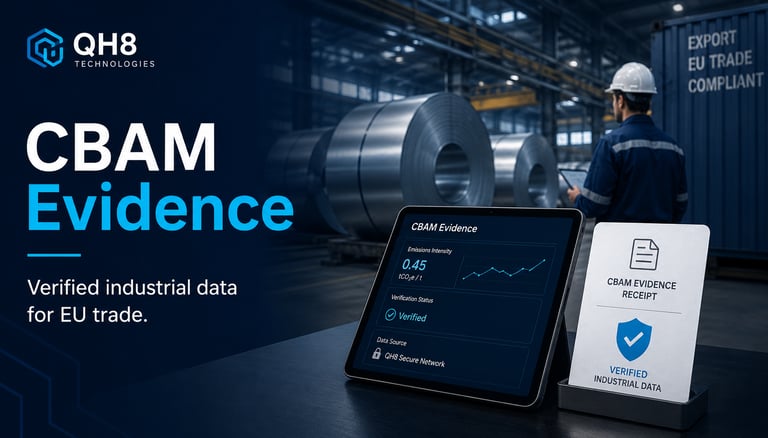
Request a sample CBAM Evidence Receipt
Schedule a technical evidence review
Assess your supplier-data risk before the next shipment
Operational Transparency Without Operational Risk
We understand the concern. Any interference with a facility’s workflow is a risk that no responsible operator is willing to take.
This is why QH8 Technologies is designed as a non-intrusive telemetric layer, not a production-control system.
How It Works: Zero-Interference Telemetry
We do not hard-wire into your systems, breach electrical panels, or alter the logic of your PLCs, controllers, or production machinery.
QH8 sensors utilize contactless electromagnetic field sensing. These sensors are installed as non-invasive clips, placed securely over the insulation of existing power cables.
Zero Circuit Disruption: No cutting, splicing, or rewiring.
Zero Logic Modification: Your production software and PLC programming remain untouched.
Zero Downtime: Standard installation does not require production stoppage or equipment shutdowns.
Turning Data Into Export Advantage
QH8 monitors your facility’s holistic energy profile: peak loads, harmonics, utilization rates, hidden losses, and consumption anomalies. These high-resolution metrics are then converted into a structured Evidence Layer—the core requirement for carbon passports, CBAM-ready reporting, and verifiable "actual-data" proof for European buyers.
Two Paths for the Industrial Exporter
Today, industrial exporters face a clear choice:
The Data-Driven Path: Deploy non-contact telemetry, identify and eliminate hidden energy waste, solidify your "actual-data" market position, and enter the European market with secured, verifiable, and compliant data.
The Reactive Path: Continue relying on manual spreadsheets, basic utility bills, and unverified declarations. This risks exposure to punitive default CBAM tariffs, intense price pressure from importers, and an inevitable loss of competitiveness within the EU market.
QH8 Technologies does not interfere with your production. We protect your data, secure your contracts, and strengthen your export position.
Ready to see how QH8 contactless telemetry works in practice?