1. What QH8 Does
QH8 provides a non-invasive telemetry and digital evidence layer for industrial facilities, infrastructure assets, and supply-chain operators.
We help replace weak data sources — spreadsheets, incomplete utility bills, manual estimates, broker-prepared PDFs, and unverified reports — with structured operational evidence.
Non-Invasive Telemetry
QH8 does not require production shutdowns, PLC rewrites, or electrical system modifications.
Our approach uses contactless EMF-based sensing to observe facility-level electrical behavior from existing power feeds.
This allows industrial operators to collect energy and operational evidence without disrupting production.
Operational Intelligence
QH8 helps identify:
Peak-demand spikes
Baseload waste
Poor load sequencing
Power-factor issues
Harmonic distortion
Cooling inefficiencies
Electrical stress patterns
Hidden capacity losses
Energy behavior affecting cost per ton
These issues affect manufacturing cost, grid capacity, carbon-related reporting, investor confidence, and buyer trust.
Cryptographic Evidence
Operational datasets can be sealed using SHA-256 records, creating a tamper-evident evidence chain for buyers, lenders, insurers, infrastructure partners, auditors, and compliance teams.
The Result
QH8 helps turn facility performance into defensible data that can support EU trade, procurement, infrastructure financing, CBAM preparation, Battery Passport readiness, energy-performance reporting, and supply-chain due diligence.
2. Who We Are Looking For
We are looking for serious local operators, industrial partners, wholesalers, developers, and infrastructure teams who understand their market and need a stronger technical edge to win larger deals.
We are not looking for passive brokers.
We are focused on three main partnership areas.
A. European Construction Materials & Regional Wholesale
Target Partners
Construction companies, regional distributors, wholesalers, importers, and project developers across the European Union, Baltics, Scandinavia, Balkans, Eastern Europe, and the Caucasus.
The Opportunity
European buyers are facing higher material costs, unstable supply routes, stricter documentation expectations, and growing pressure to verify supplier data before committing to large orders.
QH8 can support partners working with industrial and construction materials such as:
Steel
Cement
Profiles
Plastics
Insulation
Aluminum
Battery-related materials
Mining inputs
Infrastructure components
The QH8 Edge
QH8 strengthens the data layer behind the supply chain: origin documentation, energy evidence, production transparency, and buyer-ready technical records.
For wholesalers and distributors, this creates a stronger commercial position.
You are not only selling material.
You are selling material with defensible data behind it.
That matters when European buyers must justify supplier selection to procurement teams, banks, insurers, developers, and compliance departments.
B. Heavy Industry, Raw Materials & EU-Facing Exporters
Target Partners
Mining operators, steel producers, cement suppliers, fertilizer exporters, industrial manufacturers, and commodity traders across Central Asia, the Caucasus, the Black Sea region, the Balkans, and other EU-facing corridors.
The Opportunity
European buyers increasingly require stronger documentation before accepting industrial cargo.
For CBAM-covered goods, weak or incomplete production data can create commercial risk for importers and suppliers.
If buyers cannot trust the data, they may discount the cargo, delay procurement, demand stronger documentation, or shift to suppliers with better evidence.
This creates a serious opportunity for exporters who can prove their operational numbers before the buyer asks.
The QH8 Edge
QH8 helps capture and structure facility-level telemetry, energy data, production evidence, and operational records so exporters can provide stronger documentation to buyers, auditors, banks, and trade partners.
The goal is simple:
Move producers from weak paperwork to defensible operational evidence.
For EU-facing exporters, this can support:
CBAM readiness
Buyer-side carbon documentation
Supplier due diligence
Trade-finance review
Origin and production evidence
Lower friction with European procurement teams
C. European Data Centers, Grid-Constrained Projects & Industrial Infrastructure
Target Partners
European data center operators, industrial real estate developers, infrastructure funds, energy-intensive facilities, logistics hubs, manufacturing parks, and project owners facing power-capacity constraints.
The Opportunity
AI compute, advanced manufacturing, cold storage, electrification, and industrial expansion are putting serious pressure on European grids.
Many projects are delayed because usable power capacity is unclear, inefficient, or difficult to prove to lenders, tenants, regulators, and infrastructure partners.
Developers and operators need to answer practical questions:
How much usable power capacity does the site really have?
Where are peak-demand spikes damaging project economics?
Which loads are creating avoidable electrical stress?
Can energy performance be proven to tenants and investors?
Can operational records support financing and insurance discussions?
Can the project demonstrate credible infrastructure performance before capital is committed?
The QH8 Edge
QH8 identifies hidden grid waste, load inefficiencies, cooling stress, and peak-demand behavior.
The platform also creates an operational evidence record that can support investor review, lender confidence, tenant reporting, insurance documentation, and infrastructure planning.
For European developers and infrastructure sponsors, this is critical.
QH8 helps convert uncertain infrastructure claims into measurable, data-backed evidence.
That makes grid-constrained or high-risk projects easier to finance, insure, lease, and scale.
3. How We Work Together
QH8 does not replace customs brokers, statutory auditors, engineers of record, official certification bodies, or local legal advisors.
We work as the technical evidence and infrastructure intelligence layer behind the commercial process.
QH8 Provides
Telemetry architecture
Operational data capture
Digital evidence formatting
SHA-256 sealing
Technical reports
Infrastructure intelligence
Supply-chain data support
Energy-performance analysis
CBAM-readiness evidence structure
Battery Passport data-support structure
Partner-facing commercial documentation
Partner Provides
Local market access
Buyer relationships
Facility introductions
Project opportunities
Distribution channels
Local language support
Negotiation support
On-the-ground execution
Commercial intelligence from the market
The Division of Labor
QH8 provides the technology, telemetry architecture, digital evidence layer, SHA-256 sealing, and documentation structure.
What we do not provide is local market access in every region.
That is where you come in.
You identify real opportunities, reach decision-makers, and open the local commercial channel.
4. Your Exact Role
Your role depends on your geography and market position.
If You Are in Europe or Other Demand-Side Markets
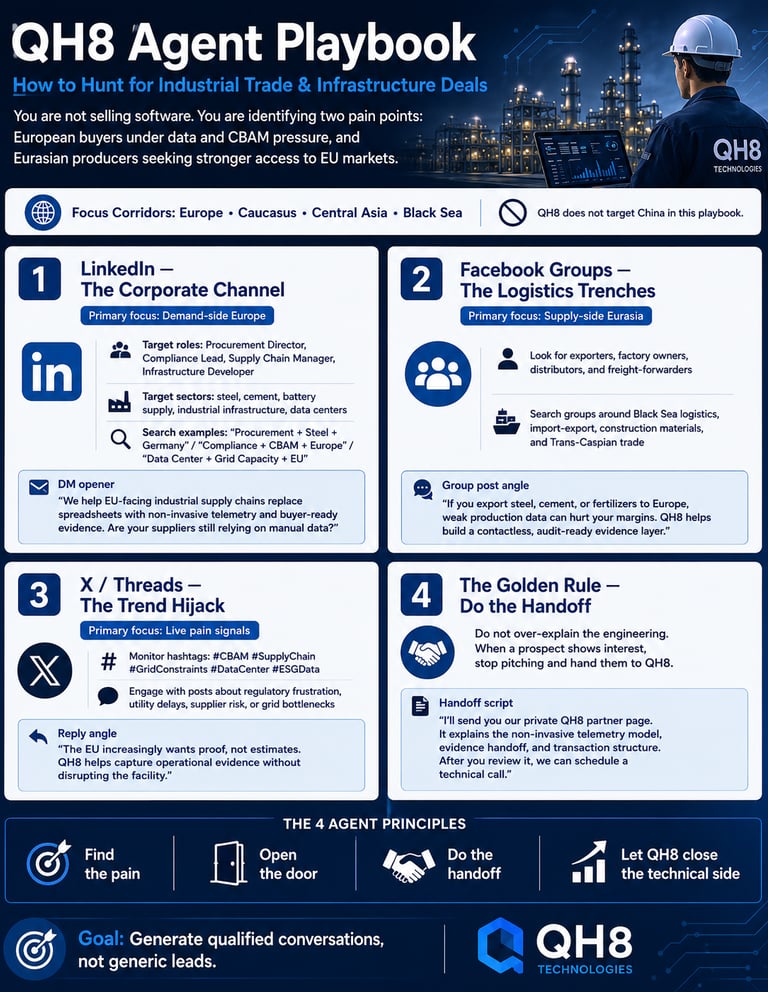
Your job is to find the buyers and project owners.
You should be speaking with:
Construction material wholesalers
Industrial developers
Data center operators
Infrastructure funds
Large construction companies
Battery-sector buyers
Manufacturing groups
Logistics companies
Procurement teams
Energy-intensive facility owners
EU importers and distributors
Your task is to identify what they are struggling with:
Materials they are overpaying for
Grid-capacity limits delaying projects
Energy-performance data they cannot prove
CBAM documentation gaps
Battery Passport data gaps
Supplier documentation they do not trust
Financing requirements tied to operational data
Insurance concerns tied to infrastructure risk
Tenant requirements for energy and uptime transparency
You bring us the buyer requirement.
QH8 helps structure the technical, data-backed solution.
If You Are in Origin Markets Supplying Europe
This includes Central Asia, the Caucasus, the Black Sea region, the Balkans, Turkey, Eastern Mediterranean corridors, and other industrial export regions connected to European buyers.
Your job is to find the producers.
You should be speaking with:
Steel mills
Cement plants
Mining operators
Fertilizer producers
Aluminum suppliers
Battery material suppliers
Industrial manufacturers
Exporters with EU-facing customers
Logistics groups moving industrial cargo into Europe
Your task is to identify which factories need stronger production data, energy evidence, origin documentation, or buyer-ready compliance support.
You bring us the facility or exporter.
QH8 helps turn their operational data into defensible commercial evidence for European buyers.
5. The Monetization & Value Model
A partnership must make commercial sense.
Depending on your role in the transaction, QH8 partnerships can create value in several ways.
Margin Protection for Wholesalers and Traders
If European buyers do not trust the data behind a product, they may discount it, delay it, or demand additional guarantees.
By helping suppliers provide stronger evidence, partners can protect pricing, defend margins, and reduce buyer hesitation.
Revenue Share for Facility and Infrastructure Deployments
Partners who introduce qualified facilities, data centers, developers, exporters, or industrial operators may participate in a structured commercial model connected to QH8 deployment, monitoring, reporting, or data-governance services.
Capital Unlock for Developers and Project Sponsors
Many projects are not blocked by demand.
They are blocked by lack of evidence.
QH8 helps provide the operational data that lenders, investors, insurers, tenants, and infrastructure partners need before committing capital.
For project sponsors, stronger evidence can help move a project from “interesting” to financeable.
Deal Acceleration for Local Operators
If you already know the buyer, factory, developer, or infrastructure owner, QH8 gives you a stronger reason to open the conversation.
You are not approaching them with a generic trade idea.
You are approaching them with a technical tool that can reduce risk, expose inefficiency, strengthen documentation, and improve commercial confidence.
6. Low-Friction Pilot Model
We do not ask partners to sell massive upfront capital expenditures before value is proven.
QH8 can start with a targeted, low-friction proof-of-value model.
The first step is usually simple:
Identify the facility, exporter, buyer, or project
Confirm the commercial problem
Review available data
Define the evidence gap
Deploy a limited telemetry or data-assessment approach where appropriate
Produce a baseline operational picture
Show where QH8 can add measurable value
The goal is to prove the opportunity before scaling the architecture.
This makes the first conversation easier for partners.
You do not need to convince a factory, developer, or data center operator to rebuild their infrastructure.
You only need to show them where weak data, hidden energy waste, unproven capacity, or missing documentation is costing them money.
7. What We Need From Potential Partners
To evaluate a partnership, we start with practical numbers, not theory.
Please send the following:
What product, facility, or infrastructure problem are you trying to solve?
What monthly or quarterly volume is realistic?
What current pricing, energy, documentation, or grid-capacity problem are you facing?
Who are the target buyers, tenants, lenders, insurers, or end users?
What documentation do they require?
What delivery terms or commercial structure are already being discussed?
Who controls the decision: buyer, owner, operator, investor, lender, or government authority?
What is the urgency: immediate deal, delayed project, compliance deadline, financing requirement, or cost-reduction target?
Once we have the numbers, we can build a clear model showing where QH8 can add technical value, reduce risk, and strengthen the transaction.
8. Who Is a Strong Fit
A strong QH8 partner has direct access to decision-makers.
You may be a good fit if you already have relationships with:
Industrial producers
Commodity exporters
Construction material buyers
EU importers
Regional wholesalers
Data center operators
Infrastructure developers
Energy-intensive manufacturers
Logistics and procurement teams
Banks, insurers, or project-finance groups
Government-linked infrastructure projects
You do not need to be a technical engineer.
But you do need to understand your market, communicate clearly, and bring real opportunities — not vague introductions.
9. Who Is Not a Fit
QH8 is not looking for passive intermediaries.
This is not a fit if:
You only want a referral link
You cannot reach decision-makers
You do not know your local market
You cannot identify a specific buyer, factory, exporter, or project
You are not willing to collect basic commercial information
You are only looking for theoretical partnerships without execution
We are building a serious partner network around real European demand, real industrial supply, real infrastructure problems, and measurable commercial value.
10. Why We Need You
QH8 brings the technical infrastructure.
You bring the local relationships, language, market access, and direct path to decision-makers.
We are looking for operators who can identify real demand, open doors, and help convert local opportunities into structured commercial deals.
You find the opportunity.
QH8 provides the technical edge to close it.
The next advantage in European industrial trade and infrastructure will not belong only to the cheapest supplier or the largest developer.
It will belong to the operator who can prove the data.
QH8 Technologies turns operational telemetry into defensible trade, infrastructure, and financing evidence for Europe-facing markets.
Strategic Partnerships Europe - Asia
EU Industrial Trade, Infrastructure, and Data-Ready Supply Chains
QH8 Technologies Partner Network
Global industrial trade is changing.
Moving materials, building infrastructure, and supplying European buyers is no longer only a logistics problem. It is now a data problem.
European buyers, banks, insurers, infrastructure investors, and procurement teams increasingly require clear operational evidence: how materials are produced, how much energy is used, where inefficiencies exist, and whether the data can be trusted.
For EU-facing supply chains, this pressure is driven by CBAM, Digital Battery Passport preparation, buyer-side carbon documentation, energy-performance requirements, and stricter supply-chain due diligence.
For European infrastructure and industrial real estate, the pressure is also coming from grid-capacity limits, financing requirements, energy-efficiency expectations, and the need to prove operational resilience before capital is deployed.
QH8 Technologies builds the technical evidence layer for this new European trade and infrastructure environment.
We are expanding our partner network across the European Union, the Baltics, Scandinavia, Eastern Europe, the Balkans, the Caucasus, Central Asia, the Black Sea region, and the Eastern Mediterranean.
Our focus is simple: connect European demand with better operational data, stronger supplier evidence, and infrastructure intelligence.
Commission Structure
Dual-Agent Split Model
QH8 contracts are enterprise-level deployments. A typical industrial telemetry node deployment, including cryptographic data-vault setup, generally ranges from $5,000 to $25,000, depending on facility size, telemetry complexity, reporting scope, and deployment requirements.
To support international trade corridors, QH8 allocates up to 50% of the contract value to qualified originating partners. This commission pool is divided based on who controls the transaction relationship.
1. Supply-Side Partner
25% Commission
Typical payout: $1,250 to $6,250 per facility deployment
This applies when you control the relationship with the origin-side facility.
Examples include:
Steel mills
Cement plants
Fertilizer producers
Mining operators
Battery material suppliers
Industrial manufacturers
Exporters supplying European buyers
Your role is to bring the facility to the table, secure management access, identify the documentation or data gap, and help coordinate the local path for QH8 deployment.
If you originate the producer, you receive the supply-side commission.
2. Demand-Side Partner
25% Commission
Typical payout: $1,250 to $6,250 per contract
This applies when you control the relationship with the European buyer, importer, developer, infrastructure sponsor, or compliance department.
Examples include:
EU importers
Construction material buyers
Industrial wholesalers
Procurement teams
Data center operators
Infrastructure developers
Banks, insurers, or trade-finance groups
Companies facing CBAM or Battery Passport documentation pressure
Your role is to identify the buyer-side pain point: missing supplier data, weak documentation, CBAM readiness gaps, grid-capacity limitations, financing requirements, or buyer due-diligence concerns.
If you originate the buyer or project owner, you receive the demand-side commission.
3. Closed-Loop Partner
50% Commission
Typical payout: $2,500 to $12,500 per deployment
This applies when you control both sides of the opportunity.
You bring the origin-side producer and the European buyer, importer, developer, or project owner into the same transaction.
Because you eliminate acquisition friction on both sides of the corridor, you receive the full commission pool.
This is the highest-value partner role.
The Rule Is Simple
If two partners help close one QH8 deployment — one on the supply side and one on the demand side — each receives 25% of the contract value.
If one partner controls the full commercial loop, that partner receives the full 50% commission.
Commissions are tied to confirmed QH8 contract revenue and are paid according to the written partner agreement once the client payment is received.
QH8 Escrow & Commission Payment Architecture
Crypto Optional. Bank Rails Fully Supported.
Not every buyer, factory, or corporate partner can use crypto.
In traditional heavy industry, this is normal. Many companies are restricted by internal compliance policies, tax rules, banking controls, or corporate treasury procedures.
That does not change the QH8 milestone model.
It only changes the payment rail.
The same commission structure can be handled through:
Standard bank wire escrow
Licensed corporate escrow account
Paymaster agreement
Documentary Letter of Credit
SEPA / SWIFT bank transfer
Hybrid fiat-to-digital settlement, where legally available
The business logic remains the same:
Funds are secured first.
Milestones are defined in writing.
Payouts are released only after the agreed QH8 delivery milestone is completed.
1. The Core Principle
Partners should not have to rely on verbal promises or delayed manual payouts.
Before work begins, the transaction structure should clearly define:
Who originated the factory
Who originated the buyer
What commission each party earns
What milestone triggers payment
Which account receives the payout
Which legal payment rail will be used
Whether the payment is made by crypto escrow, bank escrow, paymaster, or Letter of Credit, the goal is the same:
transparent commission protection for every approved party in the transaction.
2. Standard Fiat Escrow Model
If the buyer or seller cannot use crypto, QH8 can use a traditional fiat escrow structure.
In this model, the deployment fee is deposited in USD or EUR into a regulated escrow account or paymaster-controlled corporate account.
The parties may include:
European buyer / importer
Origin-side factory / exporter
QH8 Technologies
Supply-side partner
Demand-side partner
Escrow agent or paymaster
Before funds are released, the escrow agreement defines the exact milestone required for payment.
3. Example: Fiat Milestone Flow
Step 1 — Escrow Agreement Is Signed
The buyer, factory, QH8, partner, and escrow/paymaster provider sign a written agreement.
The agreement defines:
Total QH8 deployment fee
Commission split
Payment recipients
Delivery milestone
Required documentation
Dispute process
Bank account details
Release conditions
Step 2 — Funds Are Deposited
The buyer, importer, factory, or project sponsor wires the QH8 deployment fee into the escrow account.
Example:
Total QH8 deployment fee: $20,000
The escrow agent confirms that funds have been received and secured.
No partner begins serious execution until the funds are confirmed.
Step 3 — QH8 Executes the Milestone
QH8 performs the agreed technical scope.
Depending on the transaction, the milestone may include:
QH8 telemetry node installed and activated
Baseline facility data captured
SHA-256 sealed evidence package generated
Digital Supply Chain Passport delivered
CBAM-readiness data package delivered
Battery Passport data-support package delivered
Buyer or project sponsor confirms acceptance
Written milestone sign-off completed
Step 4 — Escrow Releases the Funds
Once the agreed milestone is completed and verified, the escrow agent releases payment through standard bank wires.
Payouts are made according to the written commission structure.
4. Example: $20,000 QH8 Deployment With Two Partners
Scenario:
A Georgian industrial producer needs QH8 telemetry and a sealed data package for a European importer.
One partner controls the factory relationship.
Another partner controls the buyer relationship.
Participant Role Split Payout Buyer / ImporterFunds the QH8 deployment escrow Deposit $20,000QH8 TechnologiesProvides telemetry, data sealing, reporting, and technical delivery 50% $10,000 Supply-Side Partner Introduced the factory and secured local access 25% $5,000 Demand-Side Partner Introduced the buyer or importer requirement 25% $5,000
The payout is handled through normal bank transfers, not crypto.
5. Closed-Loop Partner Example
If one partner controls both sides of the deal — the origin-side producer and the European buyer — that partner receives the full partner commission pool.
Participant Role Split Payout Buyer / Importer Funds the QH8 deployment escrow Deposit $20,000 QH8 Technologies Provides telemetry, data sealing, reporting, and technical delivery 50% $10,000 Closed-Loop Partner Controls both the producer and buyer relationship 50% $10,000
This is the highest-value partner position because it removes acquisition friction on both sides of the corridor.
6. Documentary Letter of Credit Option
For larger commodity or infrastructure transactions, the QH8 evidence package can also be included as a required document in a Documentary Letter of Credit.
In that structure, the bank does not release payment until the required documents are presented.
Depending on the deal, the QH8 deliverable may be listed as one of the required presentation documents, such as:
Digital Supply Chain Passport
SHA-256 sealed telemetry report
CBAM-readiness data package
Energy evidence report
Facility telemetry confirmation
Battery Passport data-support file
This structure is useful when the QH8 evidence package is tied directly to a larger cargo, procurement, or trade-finance transaction.
7. Hybrid Fiat-to-Digital Model
Some partners may prefer digital settlement, while corporate buyers may only be allowed to pay by bank transfer.
In that case, a hybrid structure may be used where legally available.
The buyer pays a normal corporate invoice in EUR or USD.
A licensed payment provider, escrow provider, or settlement partner may then convert or route the funds according to the agreed structure.
From the buyer’s side, the process looks like a standard bank payment.
From the partner’s side, payout may be received through the agreed settlement method.
This option depends on jurisdiction, banking rules, compliance approval, and the provider used.
8. The Rule Is Simple
If the client cannot use crypto, the deal does not stop.
We use fiat rails.
The commission model remains the same:
25% to the supply-side partner
25% to the demand-side partner
50% to the closed-loop partner if one person controls both sides
The payment method can change.
The milestone logic does not.
9. Why This Matters for Partners
This structure protects serious partners.
It prevents unclear promises, delayed payouts, and disputes after the deal closes.
Each approved partner knows in advance:
What they are owed
When they are paid
Who releases payment
Which milestone triggers release
Which bank account or wallet receives funds
This makes the QH8 partner model practical for traditional factories, European importers, infrastructure developers, and corporate buyers that cannot or will not use crypto.
QH8 is flexible on payment rails.
We can support crypto escrow where appropriate, but we do not require it.
For traditional industrial clients, we can operate through standard bank wires, fiat escrow, paymaster agreements, or Letter of Credit structures.
The principle is always the same:
secure the funds, define the milestone, deliver the QH8 evidence package, and release the agreed commission split transparently.